

UNITE.rehab.perform
Denver's Best Sports Physical Therapy
What We Look for When Evaluating an Athlete
Written by: Dr. Victoria Riester, PT, DPT
As sports performance physical therapists, and athletes ourselves, we understand firsthand how frustrating it can be when pain takes you away from the sport you love.
That’s why our evaluations go beyond simply finding the painful spot.
We want to understand why it hurts, what may be contributing to it, and how your entire body is moving and working together.
No more guessing. No more endless modifications. No more leaving an appointment with unanswered questions.
Just a clear understanding of what we find and a plan for what comes next.
So what actually happens in a physical therapy evaluation with us? We start with your story and your goals, look at how your whole body moves, then zoom in on the details: mobility, strength, balance, control, and how you handle load. Here’s what that looks like.
The Big Picture
Every evaluation starts with your story.
What brought you in? When did the pain start? Was there an injury? Does it happen during a specific movement or activity? Have you dealt with this problem before?
These details give us important clues.
Hip pain after a skiing accident tells us something different than gradual-onset hip pain in a runner. Long-term knee pain in a distance runner may have different contributing factors than knee pain that started after a change in training.
Your symptoms are the starting point…not the entire picture.
From there, we want to see how you move as a whole athlete.
How do your hips, knees, ankles, spine, shoulders, and other areas of your body work together? Are you able to control movement the way your sport demands? Do you have the mobility, strength, coordination, and capacity needed for what you’re asking your body to do?
This bigger-picture assessment helps guide us toward the deeper factors that may be contributing to your symptoms. It’s the heart of your free 30-minute movement assessment with us.
For a lot of people, this is where an evaluation ends. For us, it’s just the starting point.
Talk with our team today. [Book Your Free Movement Assessment]
The Smaller Details
Once we understand the big picture, we zoom in. That’s what our one-hour initial evaluation is built for: a head-to-toe, joint-by-joint, muscle-by-muscle deep dive.
This is where the details matter.
We may look at joint mobility, strength, balance, coordination, movement control, tissue capacity, and how you respond to specific movements or loads.
For example, someone with knee pain may not have a problem that is isolated to the knee.
We may find differences in hip strength or control. Limited ankle mobility. A movement strategy that changes as fatigue sets in. Or a mismatch between what the athlete is capable of and the demands they are placing on their body. Sometimes it comes down to whether you need more mobility or more stability, and the answer isn’t always what you’d expect.
The same principle applies to shoulder pain, back pain, hip pain, ankle injuries, and recurring muscle strains.
We aren’t just asking, “Where does it hurt?”
We’re asking, “What is happening throughout the system when you perform the movement that causes your symptoms?”
That distinction matters.
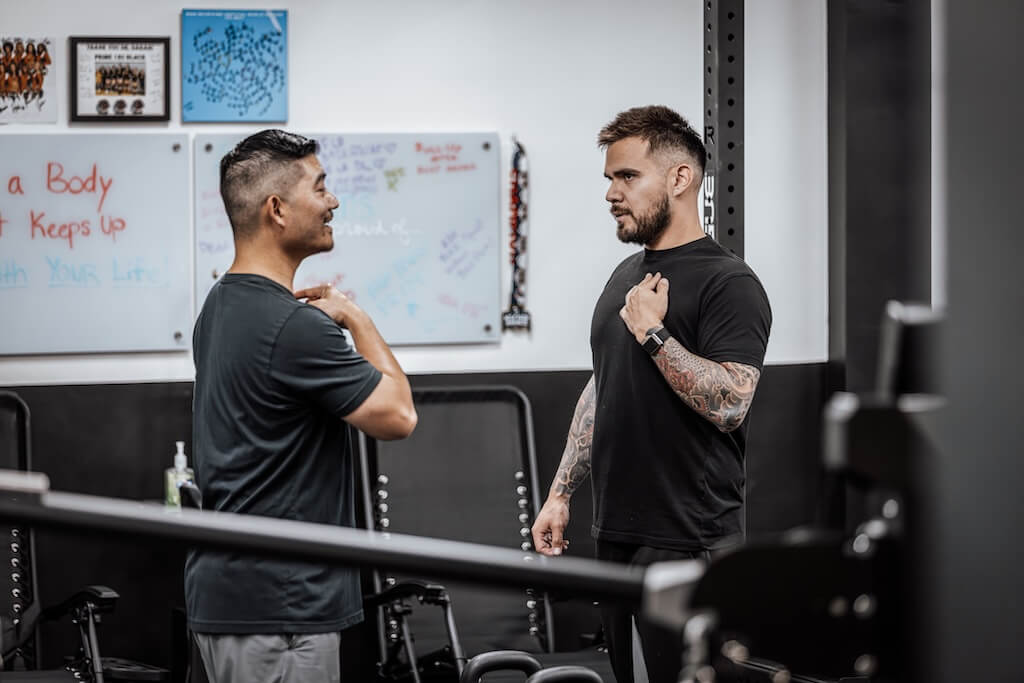
Tying It All Together
The goal of our evaluation isn’t to hand you a list of things that are “wrong” with you.
It’s to connect the dots for you and come up with a full game plan to address the movement issues in a way that decreases the chances that they come back.
Your history gives us context.
Your movement gives us information.
Your strength, mobility, control, and sport-specific demands help us understand how those pieces fit together.
Then we explain what we find…and, most importantly, why it matters to you and your goals.
Because a runner shouldn’t just want their knee to feel better walking around. They want to run.
A CrossFit athlete doesn’t just want a pain-free shoulder. They want to lift, train, and participate without constantly modifying everything.
A volleyball player doesn’t just want their knee to feel okay on the stairs. They want to jump, land, and get back on the court.
A skier doesn’t just want their hip to feel better in the clinic. They want to get back on the slopes, which means preparing their body for ski season, not just calming the pain down.
That’s why our approach to sports physical therapy is centered around the athlete…not just the injury.
What to Expect at Your First Visit
Knowing what you’re walking into makes it a lot easier to take the first step. Here’s how it works with us.
Step 1: Your free 30-minute movement assessment. This is where everyone starts. One of our doctors will hear your story, take you through a broad movement screen to see how you move as a whole, and run an injury risk assessment to flag anything that could become a problem. It’s a low-pressure way to get answers and see if we’re the right fit.
Step 2: Your one-hour initial evaluation. This is where we zoom in, and it’s built to answer three questions: What’s happening? Why is it happening? And what’s the full diagnosis? You won’t leave with information alone, though. Treatment starts that same visit, based on what we find. That may include hands-on treatment, dry needling, laser therapy, shockwave, or blood flow restriction therapy.
Step 3: Your plan. From there, we map out what comes next, built around your sport, your goals, and your schedule.
As for what to wear, come in clothes you can move in, the same kind you’d train in. If it’s your knee or hip that’s bothering you, shorts make it easier for us to see what’s going on. Bring the shoes you train in, along with any imaging reports or surgical notes you have.
How Payment Works at UNITE
Your first step costs nothing. The 30-minute movement assessment is free, so you can get answers and get a feel for how we work before committing to anything.
From there, we’re a cash-pay physical therapy practice. Because we work directly with you rather than through an insurance company, your plan is built around what you need to get back to your sport, not around insurance visit limits or approvals.
Want to use your insurance? Many plans include out-of-network physical therapy benefits, and we’ll provide a superbill, a detailed receipt you can submit for possible reimbursement. A quick call to your insurer before your first visit will tell you what your plan covers.
Beyond Pain Relief
Our goal isn’t simply to get you out of pain.
It’s to help you understand your body, identify the factors that may be limiting your performance, and build a plan that gets you back to doing what you love.
Because you are more than your injury…and your evaluation should be, too.
Get started with our team today. If you’ve been looking for sports physical therapy in Denver that treats you like the athlete you are, your first step is a free 30-minute movement assessment.
Key Takeaways
- — Pain is rarely about one body part, so we look at the whole athlete, not just the spot that hurts.
- — Every evaluation starts with your story and your goals.
- — Your free 30-minute movement assessment looks at how you move as a whole and flags injury risk.
- — Your one-hour initial evaluation goes joint by joint and muscle by muscle to explain what’s happening and why, and treatment starts that day.
- — The goal is a plan built around your sport, not just getting you out of pain.
Frequently Asked Questions
What happens during a physical therapy evaluation?
With us, it happens in three steps. First, a free 30-minute movement assessment looks at how you move as a whole and flags any injury risk. Next, a one-hour initial evaluation goes joint by joint and muscle by muscle to find what’s happening, why it’s happening, and a full diagnosis, with treatment starting that same day. Finally, we build a plan around your sport and your goals.
How long does a physical therapy evaluation take?
Your free movement assessment takes about 30 minutes. A full initial evaluation takes about an hour, and that includes your first treatment.
What should I wear or bring?
Clothes you can move in, the shoes you train in, and any imaging reports or surgical notes you have. Shorts are helpful if your knee or hip is the issue.
Do I need a referral to see a physical therapist in Colorado?
In most cases, no. Colorado allows direct access, so you can book with a physical therapist without a referral from your doctor. Some insurance plans still require one for reimbursement, though, so check with yours if you plan to submit a superbill.
What’s the difference between the free movement assessment and a full evaluation?
The movement assessment is a 30-minute big-picture look at how you move and where your injury risks are. The initial evaluation is an hour-long, joint-by-joint deep dive that ends with a full diagnosis and your first treatment. Think of the first as finding out whether something needs a closer look, and the second as that closer look.
What happens after my evaluation?
You’ll leave with a clear explanation of what we found and a plan built around your sport and goals. From there, that plan can include ongoing treatment and progressing into performance training to get you back to full speed and keep the problem from coming back.
Don’t leave it to chance.
Let Denver’s premier team of sports physical therapists and performance coaches lead the way!
©2020-2025 UNITE.rehab.perform LLC. All rights reserved.
UNITE.rehab.perform does not provide medical advice, diagnosis, or treatment through this website or related content. See additional information.