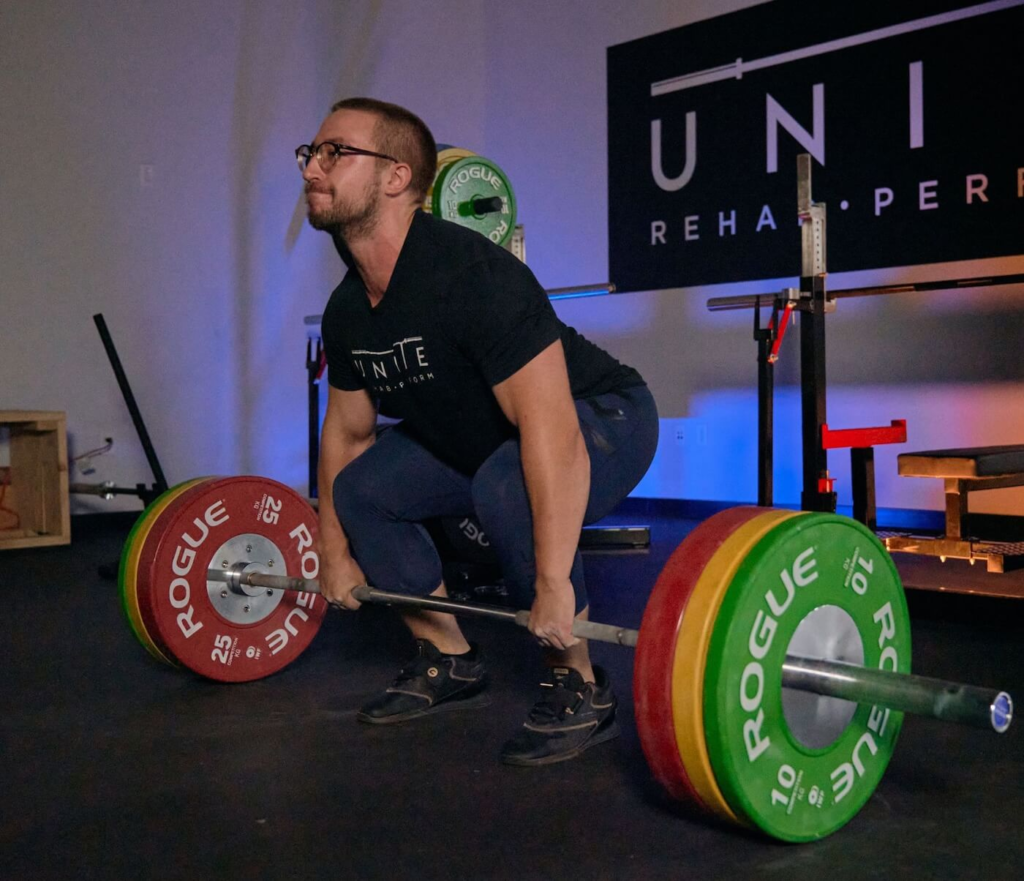
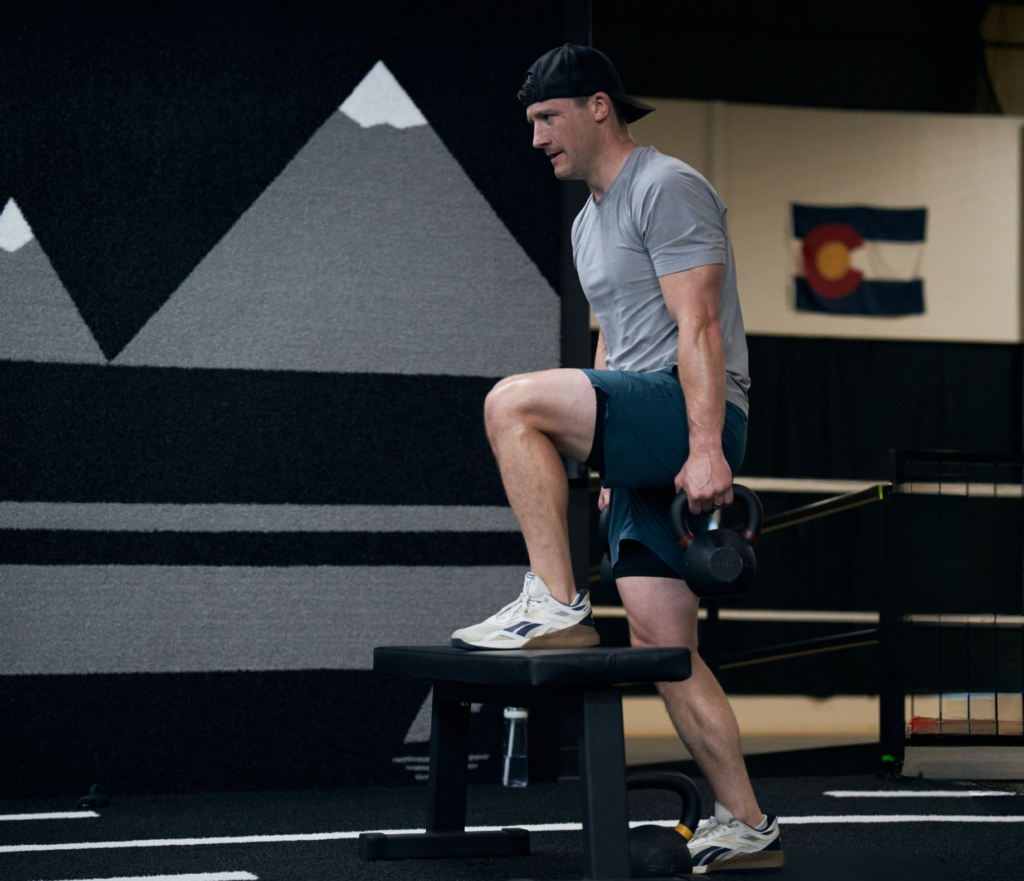
Why Does Knee Pain Happen During CrossFit?
Knee pain in CrossFit typically comes down to one equation:
Load exposure vs load tolerance.
Load exposure is what your knee is asked to do:
- — High training volume
- — Heavy barbell intensity
- — Deep squat depth
- — Box jumps and rebound work
- — Running intervals
- — Fast deceleration under fatigue
Load tolerance is what your knee can currently handle:
- — Quad and glute strength
- — Tendon health and stiffness
- — Hip and ankle mobility
- — Neuromuscular control
- — Recovery quality
- — Gradual progression in training
Knee pain occurs when load exposure exceeds load tolerance.
That does not mean tissue is damaged. It means your knee is being asked to do more than it is prepared for.
The Knee Is Often the Middleman
The knee rarely fails on its own.
It sits between the hip and the ankle. If either of those regions underperform, the knee absorbs extra stress.
How hip and ankle strength affect knee health:
- — Weak hips allow the femur to rotate inward, increasing stress on the kneecap
- — Limited ankle mobility shifts load forward into the knee during squats and landings
- — Poor trunk control alters force transfer during lifts
Most patellofemoral pain in athletes is not a kneecap problem. It is a force distribution problem.
Common Sources of Knee Pain in CrossFit
If your knees hurt during squats or WODs, here are the most common culprits we see:
Patellofemoral Pain Syndrome
Pain around or behind the kneecap. Often worse with stairs, wall balls, and deep squatting. Common in high-volume training phases.
Patellar Tendinopathy in CrossFit
Pain at the tendon just below the kneecap. Often aggravated by box jumps, double unders, and high-speed deceleration. This is a tendon load tolerance issue.
Meniscus Irritation
Joint line tenderness or clicking with deep flexion or rotation. Often load-related rather than structural breakdown.
IT Band Related Pain
Lateral knee pain that increases with running or repetitive flexion under fatigue.
Pain does not automatically mean structural damage. MRI findings often show wear and tear in completely pain-free athletes.
The question is not “What does the MRI say?”
The question is “Can your knee handle your training demands?”
Why Do My Knees Hurt During Box Jumps or Squats?
High-rep squatting and jumping create significant eccentric load.
Eccentric strengthening for knees is critical because:
- — Tendons need gradual loading to increase stiffness
- — Deceleration control protects the joint
- — Rebound work amplifies force exposure
If you increase jump volume or squat intensity rapidly, tendon irritation can show up quickly.
This is especially true in patellar tendinopathy CrossFit athletes.
Simple Warm-Up and Prehab Drills for CrossFit Knee Injury Prevention
What prehab exercises can reduce knee stress?
These drills improve knee load tolerance, hip control, and ankle mobility. Add them before training.
Mobility Reset
- — Quadruped Rocks x5
- — Long Adductor Rocks x5 each side
- — Side Sit Thread the Needle x5 each side
- — Quadruped Hover and Rock x10
Stability and Strength
- — Star Plank Isometric 30 seconds
- — Adductor Plank Isometric 30 seconds
- — Glute Bridge with ASLR x10 each side
- — Cross Crawl RDL x10
- — Lateral Band Walks 15 yards
These address hip and ankle strength for knee health and improve force distribution before heavy lifts.
How to Safely Train With Knee Irritation
If your knee is irritated mid-WOD:
- — Reduce depth temporarily
- — Decrease jump volume
- — Slow eccentric phases
- — Modify range without abandoning the movement
- — Prioritize controlled tempo work
Pain does not always equal damage, but it is feedback.
Smart modification builds capacity. Blindly pushing volume reduces it.