
Close

Why ChatGPT Shouldn't Replace a Physical Therapist for Pain or Injury

Written by Dr. Victoria, DPT

“Let’s see what ChatGPT has to say.”

We’ve all done it. A twinge in your knee, tightness in your back, a nagging shoulder that won’t quit — and within seconds you’re down a rabbit hole of AI-generated advice and generic exercise lists.

Here’s the honest answer to the question we get asked more than you’d think: AI tools like ChatGPT can provide general health information, but they cannot assess movement, diagnose injuries, or create personalized treatment plans — making them unreliable for treating pain.

That’s not a knock on the technology. It’s just the reality of what good rehab actually requires.

Can ChatGPT Help With Pain or Injuries?

To be fair — yes, in limited ways.

What AI can help with:

  • — General education about conditions and anatomy
  • — Understanding terminology before an appointment
  • — Generating broad exercise ideas for healthy individuals
  • — Answering basic “what is this” questions

What AI cannot do:

  • — Diagnose an injury or movement dysfunction
  • — Assess how your body actually moves
  • — Identify the root cause of your pain
  • — Build or adapt a treatment plan based on how you respond
  • — Know when an exercise is making things worse

The gap between those two lists is exactly where people get into trouble. AI gives you a starting point. It can’t tell you if that starting point is right for you,  or actively making things worse.

Why AI Advice Falls Short for Physical Therapy

At UNITE, we work daily with people dealing with low back pain, knee pain, hip pain, sports injuries, and everything in between. And a pattern we see constantly: someone tried the AI route first, spent weeks on generic advice, and showed up to us with the same problem — sometimes worse.

Here’s why that happens.

ChatGPT works through pattern recognition. It pulls from a massive pool of general information and generates the most statistically likely response. That’s useful for a lot of things. But pain and injury are not average problems. They’re your problem — shaped by your movement history, your tissue capacity, your training load, your compensations, and a dozen other variables that no algorithm has access to.

AI cannot replace a physical therapist because it cannot assess movement, identify root causes, or adapt treatment in real time. Those aren’t minor gaps. They’re the entire job.

The Problem With One-Size-Fits-All Rehab Plans

Generic advice exists because it works for someone. The issue is that “someone” might not be you.

The same knee pain presentation can come from a hip stability deficit, a quad weakness, a movement pattern issue, or a load management problem — and the right intervention is completely different depending on which one it is. A generic protocol doesn’t sort that out. It just picks the most common answer and hopes it lands.

As physical therapists and performance coaches, we build every plan around you specifically: your movement patterns, your injury history, your goals, and your lifestyle. Effective rehab depends on personalization, not general recommendations.

The right exercise for the wrong problem doesn’t just fail to help. It can make things worse.

Risks of Following Generic Injury Advice

This is where the stakes get real.

  • — The wrong exercise can worsen symptoms or reinforce poor movement patterns
  • — Underlying contributors — hip weakness, poor mechanics, load issues — go undetected
  • — You make progress on the symptom while the actual problem compounds
  • — A manageable issue becomes a longer, harder rehab

Every week spent on the wrong plan is a week not moving toward full performance.

Signs You Should See a Physical Therapist

Stop waiting if any of these apply:

  • — Pain lasting more than 1–2 weeks without improvement
  • — Pain that gets worse with activity, not better
  • — The same injury keeps coming back
  • — Loss of strength, range of motion, or mobility
  • — You’ve tried the generic stuff and it hasn’t worked

These aren’t signs that you’re broken. They’re signs that your body is telling you something specific, and you need someone who can actually listen to it.

The UNITE Approach: Assess, Fix, Build

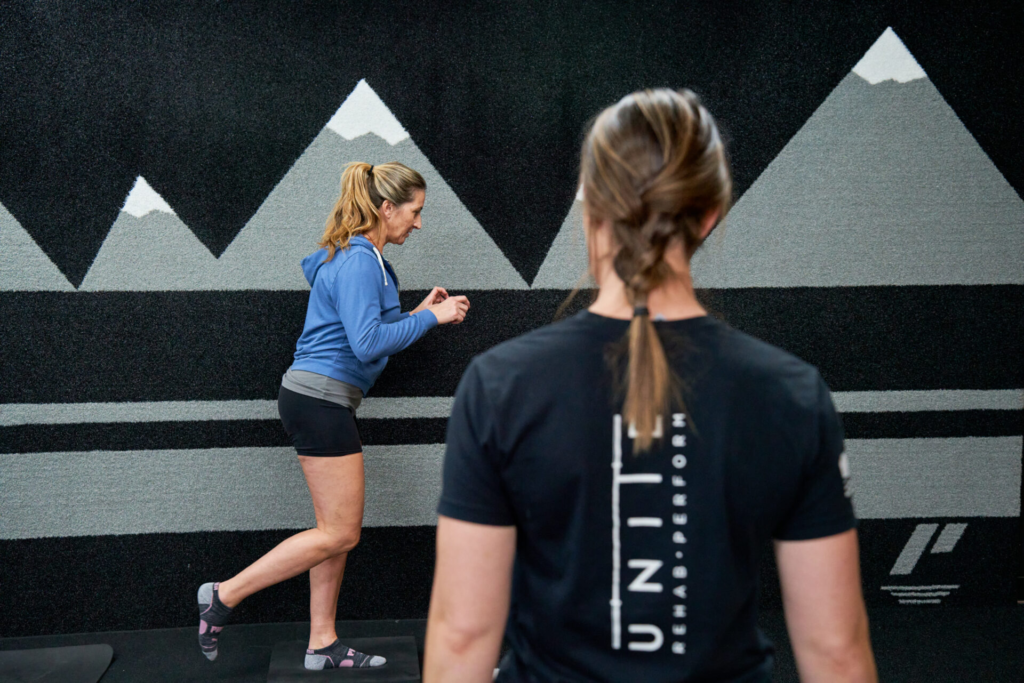
As physical therapists, we evaluate how your body moves in real time to identify the root cause of pain — not just treat the symptom you walked in with.

At UNITE, that means a structured process from day one:

Assess — We look at how you move, where the breakdown is, and what’s actually driving your symptoms. No assumptions, no generic protocols.

Fix — We build a plan around your specific findings and adapt it in real time as you respond. When symptoms shift, the plan shifts with them.

Build — Recovery isn’t the finish line. We transition athletes and active adults into training that builds the capacity to stay out of pain and perform at a higher level long-term.

That’s the model. Rehab and performance aren’t separate things here — they’re part of the same continuum.

[See our full approach →]

The Bottom Line

ChatGPT is a useful tool. It’s not a clinician.

When it comes to pain, injury, and getting back to doing what you’re built to do, you need someone who can see you move, identify what’s actually wrong, and build a plan that’s specific to you. That’s not something any AI can do yet.

If you’ve been managing pain on your own and not getting the results you want, it’s time to stop guessing and get assessed.

Personalized care wins. Every time.

Book your evaluation at UNITE →

Don’t leave it to chance.

Let Denver’s premier team of sports physical therapists and performance coaches lead the way!