UNITE.rehab.perform
Denver's Best Sports Physical Therapy
Before You Train Through Pain: Why Physical Therapy Comes First in Your 40s
Written by Dr. Victoria Riester, PT, DPT Performance Physical Therapist at UNITE.rehab.perform | BS Exercise Science, Ball State University | Doctorate in Physical Therapy, Governors State University
But your body does not play by the same rules anymore.
That nagging shoulder, knee, or low back pain is not just “tightness” or something you can outwork. And continuing to train through it the way you did in your 20s is often what turns a small issue into a long-term problem.
The good news? Your 40s do not have to mean slowing down. But they do require a different approach to how you train, how you recover, and how you handle pain when it shows up.
Why Your 40s Are Different
Your body can still perform at a high level. That has not changed. What has changed is the margin for error. The things you used to get away with, skipping warm-ups, ignoring minor aches, training the same way year after year, start to carry consequences that compound instead of resolve on their own.
Here is what is actually happening:
Slower recovery capacity.
Your body still adapts. It just needs more time and more intentional programming to get there. Training hard without addressing underlying movement issues, strength deficits, or mobility restrictions stacks fatigue faster than you can recover from it.
Decreased tissue elasticity.
Muscles, tendons, and ligaments lose some of their natural tolerance over time. That means less room for poor movement patterns or repetitive overuse before something starts to break down.
Accumulated wear and tear.
Years of lifting, running, competing, and sitting at a desk all add up. Small inefficiencies that went unnoticed for a decade become real problems when the body’s tolerance margin narrows. Something has likely been building for a while before the pain ever shows up.
Hormonal changes.
Shifts in hormones affect muscle mass, joint health, and recovery capacity, making you more susceptible to injury if your training approach does not evolve with your body.
None of this means you need to slow down. It means you need to be smarter about how you train, recover, and address issues when they appear.
The Difference Between Soreness and Injury
This is one of the most commonly misunderstood distinctions in fitness, and getting it wrong is often what turns a manageable issue into a chronic one.
Normal Soreness | Potential Injury |
Improves within 48 hours | Persists for weeks |
Symmetrical muscle discomfort | Localized joint or tendon pain |
Improves with movement and warm-up | Worsens with activity |
Does not change how you move | Causes compensation or avoidance |
General muscle soreness after a hard session is a normal part of training at any age. Pain that lingers beyond a couple of days, gets worse when you train, or changes the way you move is a different signal entirely.
Active adults in their 40s often have a harder time distinguishing between the two because a baseline level of stiffness and discomfort has become their normal. That normalization is exactly what allows small problems to go unaddressed long enough to become significant ones.
Common Injuries Active Adults Experience After 40
Certain areas tend to show up repeatedly in the active adult population:
Shoulder pain. Rotator cuff tendinopathy and impingement are common in lifters and former overhead athletes. Pain during pressing, reaching overhead, or sleeping on the affected side are typical early signs.
Knee pain. General wear, patellofemoral discomfort, and meniscal irritation become more common, especially in runners, lifters, and anyone with a history of sport participation.
Low back pain. Often driven by a combination of prolonged sitting, core weakness, and movement patterns that have gone unaddressed for years. One of the most common and most treatable conditions in this population.
Hip pain. Labral irritation, hip flexor tendinopathy, and general mobility restrictions become increasingly common, particularly in adults who sit for most of the day and then train at high intensity.
The common thread across all of these: they rarely show up overnight. They develop gradually as training demands exceed the body’s current capacity to absorb them.
The Real Risk of Training Through It
This is where most people get stuck, and it is not because they are lazy. It is because they are disciplined. They keep going. But here is what actually happens when pain goes unaddressed:
Small issues become chronic injuries. That minor knee irritation turns into persistent pain that shows up in every workout.
Compensation patterns develop. A hip limitation leads to back pain. A shoulder issue leads to neck tension. Your body finds a way around the problem, but not an efficient one.
More time away later. Ignoring it now often means being forced to stop later for a significantly longer period.
Performance slowly declines. You might still train, but you are not progressing the way you used to and you cannot figure out why.
The frustrating part is that most of these situations are preventable. The issue is rarely that the body cannot handle the training. It is that something specific has been limiting its ability to do so, and no one has identified what it is.
Physical Therapy Is Not a Last Resort. It Is a Performance Tool
Most people wait too long to address pain. They try rest, stretching, or modifying workouts until nothing works anymore. That is backward.
Physical therapy should be the first move, not the last.
What it actually does when done right:
Identifies the root cause. Not just where it hurts, but why it hurts. Often, the source of pain is not where you feel it. A good physical therapist does not chase the pain. They get to the bottom of it and help you understand the “why” behind the “what.”
Restores mobility and stability. You do not just get “looser.” You learn to move better, with control.
Improves movement quality. Better mechanics mean less stress on joints and more efficient performance. This means less likelihood of that nagging issue returning.
Prevents future injury. When you move more efficiently and with appropriate patterns, the same injuries are far less likely to come back.
Enhances strength and performance. When your body moves well, strength training actually supports you rather than working against you.
Physical therapy not only reduces pain but also improves movement quality, mobility, strength, and recovery, helping active adults train more efficiently and perform at a higher level.
Why Recovery Matters More Than Ever
In your 20s, recovery happened whether you thought about it or not. In your 40s, recovery either gets intentional or performance declines. There is not much middle ground.
The areas that make the biggest difference:
Sleep. Recovery happens primarily during sleep. If you are consistently under-sleeping, your body cannot complete the repair and adaptation process that training is supposed to trigger. Protecting sleep is one of the highest-return investments an active adult can make.
Strength training. This is not just about performance. After 40, progressive strength training is essential for maintaining muscle mass, supporting joint health, and keeping your body resilient enough to handle the activities you love.
Mobility work. Not random stretching. Targeted mobility that addresses the specific restrictions limiting your movement quality. Five to ten minutes of intentional work daily is more valuable than an hour of general stretching once a week.
Stress management. Physical stress from training and mental stress from life draw from the same recovery pool. An athlete who trains hard and sleeps well but lives in a state of constant stress is still under-recovering.
A Quick Story
We recently worked with a client in their mid-40s. Former athlete, still training consistently.
They came in with persistent shoulder pain that had been hanging around for months. They had tried everything: rest days, ignoring it, lighter weights, mobility work they found online. Nothing stuck.
After a full assessment, the issue was not just the shoulder. The problem was actually coming from a combination of limited mid-back (thoracic) mobility and poor shoulder blade (scapular) control.
Once we addressed the root problem, pain decreased within weeks, strength numbers went back up, and they returned to training without modifying every movement to work around the injury.
Not only were they pain-free. They were performing better than before.
What Happens During a Physical Therapy Evaluation?
If you have never been through a performance-focused physical therapy evaluation, here is what to expect at UNITE:
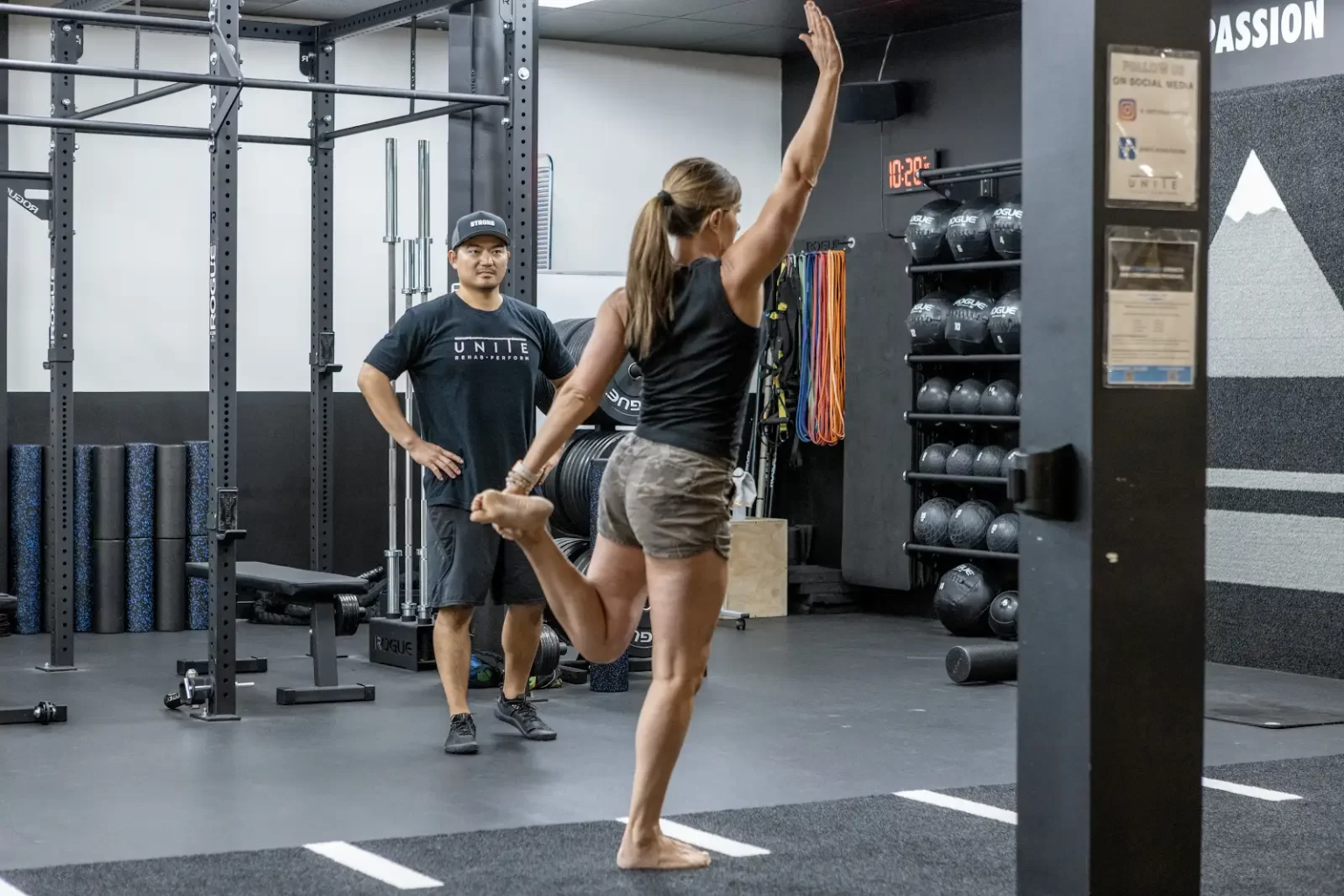
Movement assessment. We watch how you actually move, under different demands and positions, to identify the patterns and compensations driving your symptoms. This is not a quick screen. It is a thorough look at the whole picture.
Strength testing. Identifying where strength deficits exist so we know exactly what needs to be built up, not guessed at.
Mobility screening. Determining which joints are moving well and which are restricted, and how those restrictions are affecting the rest of the chain.
Personalized action plan. Based on all of the above, you leave with a clear understanding of what is going on, why it is happening, and what the plan is to fix it. No ambiguity, no generic handouts.
Frequently Asked Questions
Should I stop training completely if I have pain?
Not necessarily. In many cases, you can keep training with appropriate modifications. The key is identifying which movements or intensities are aggravating the issue and addressing the underlying cause, not just avoiding pain blindly. A professional evaluation helps you stay active while the problem is being resolved rather than sitting on the sidelines guessing.
How do I know if pain is “normal” or something I should address?
General muscle soreness that resolves within 48 hours is expected. Pain that lasts more than one to two weeks, gets worse with activity, or changes how you move is worth getting evaluated. If you find yourself consistently modifying exercises or avoiding movements you used to do without issue, that is a clear signal.
Can physical therapy actually improve my performance, or just reduce pain?
Both. When your body moves better, you generate force more efficiently, recover faster between sessions, and train more consistently. That combination leads directly to better performance over time. Many of our clients end up stronger and more capable after addressing their limitations than they were before the pain started.
When is the right time to see a physical therapist?
Earlier than most people think. If something feels “off” and is not improving within a couple of weeks, that is usually the ideal window to step in. Catching it early almost always means a faster resolution and less time away from the training you enjoy.
Keep Training Without Letting Pain Dictate Your Performance
If shoulder, knee, hip, or back pain has been lingering for more than a few weeks, an evaluation can help identify the cause and create a plan to keep you active and performing for years to come.
Dr. Victoria Riester, PT, DPT
Dr. Victoria Riester, PT, DPT is a Performance Physical Therapist at UNITE.rehab.perform in Thornton, CO. A former competitive cheerleader and volleyball player, Dr. Victoria experienced low back pain firsthand as an athlete and found traditional PT falling short. That experience drives her approach today: movement-based, athlete-focused care designed to get people back to sport and keep them there.
Don’t leave it to chance.
Let Denver’s premier team of sports physical therapists and performance coaches lead the way!
©2020-2025 UNITE.rehab.perform LLC. All rights reserved.
UNITE.rehab.perform does not provide medical advice, diagnosis, or treatment through this website or related content. See additional information.