Inside the Session: How a Pro Volleyball Workout Is Built
1. Dynamic Warm-Up
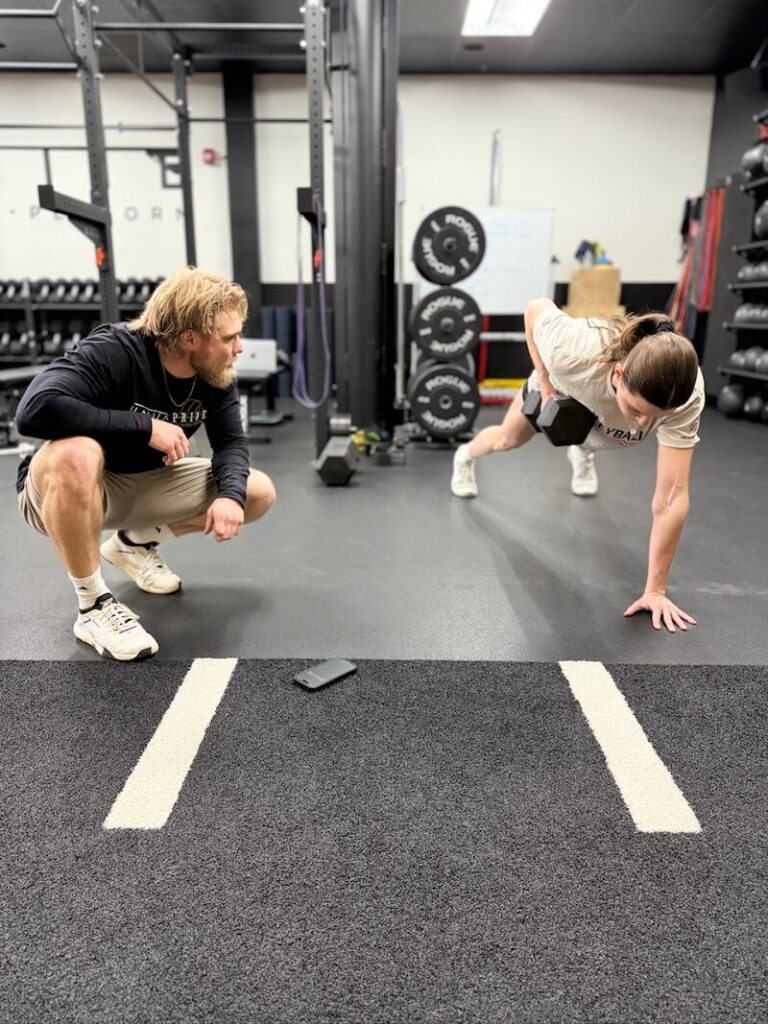
Like any athlete at any level, Danielle’s session starts with a purposeful dynamic warm-up. No wasted movements. Everything is selected to prepare her body for the specific positions and demands she will be exposed to during that day’s training.
Efficiency matters when working with athletes, so the warm-up also serves double duty. I use this window to sneak in accessory work that targets Danielle’s current weaknesses and challenges smaller muscle groups through coordination and stability. By the time the warm-up is done, she is not just loose. She is activated and ready to produce.
2. Nervous System Activation
After the warm-up, we transition into what I call the activation phase: exciting the nervous system and priming the body for peak output.
The training adaptations an athlete gets are proportional to the intensity they can produce. If we can elevate the nervous system before the primary work begins, every rep that follows becomes more productive. More force, more speed, better results from the same exercises.
This is where techniques like overcoming isometrics come in. For a deeper look at how and why we use them, check out [Overcoming Isometrics: How Pro Athletes Prime the Nervous System for Explosive Performance].
3. Primary Power Movement
This is the most important objective of the day, and it goes first, before fatigue has any chance to interfere with intensity.
For Danielle, the primary focus is explosive lower body training. As a middle blocker, her game lives and dies on her ability to get off the ground quickly, repeatedly, and with enough force to dominate the net. Step quickness and vertical power are non-negotiable qualities for her position.
The specialized training technique we use to develop Danielle’s explosive ability and vertical jump is French Contrast Training, a method designed to take advantage of post-activation potentiation and progressively increase speed and power output within a single training sequence. For a full breakdown, check out [French Contrast Training for Vertical Jump: Add 3 to 5 Inches With This 4-Step Method].
4. Supplementary Strength Work
After the primary objective is complete, the rest of the session focuses on movements that complement what came before and keep the athlete well-rounded.
For Danielle, that means posterior chain work to balance out the quad-dominant power training from earlier in the session. Volleyball is heavily anterior-chain loaded, with jumping, landing, and decelerating all placing significant demand on the quads and knees. Posterior chain strength (glutes, hamstrings, back) is what keeps that equation balanced and protects against the overuse patterns that sideline volleyball players.
5. Core and Pillar Training
Core work for a volleyball player is not about crunches or planks held for time. It is about developing three-dimensional stability and the ability to transfer energy efficiently.
When Danielle swings, force originates from the ground, travels through her hips and trunk, and delivers through her arm and hand. Any breakdown in that chain means lost power and increased stress on the shoulder. Pillar strength is what keeps that transfer clean and keeps her hitting with force without compensating through her back or shoulder.
6. Upper Body Strength
Volleyball players hit, block, and serve hundreds of times per week in season. The shoulder takes a beating. Upper body strength work in the program is not about building mass. It is about building the structural durability to handle that volume without breaking down.
Shoulder health and upper body strength are inseparable for volleyball players. The stronger and more stable the shoulder complex, the more resilient it becomes under the repetitive demands of the sport.
7. Recovery
After the session, like the pro she is, Danielle immediately kicks off the recovery process.
She refuels with a combination of carbohydrates to replenish energy stores and protein to support muscle tissue repair so she comes back to the next session stronger than before. Without high quality fuel in the tank, the Ferrari ceases to perform.
Most importantly, Danielle prioritizes sleep. Without eight-plus hours, we do not just increase injury risk. We dampen the body’s ability to rebuild, recover, and adapt. The training stimulus only becomes a training adaptation when the body has the time and resources to complete the process.
Training like a pro means mastering the basics and taking advantage of the low-hanging fruit: sleep, nutrition, and consistency. The athletes who get the most out of their training are not the ones doing the most complex exercises. They are the ones who never skip the fundamentals.