UNITE.rehab.perform
Denver's Best Sports Physical Therapy
How to Fix Jumper's Knee (Patellar Tendinopathy)
Written by Coach Francis, CSCS Strength and Performance Coach at UNITE.rehab.perform | CSCS Certified | Specializing in Youth Athletic Development and Long-Term Performance Training
Patellar tendinopathy is an overuse tendon injury causing pain below the kneecap due to repetitive loading from jumping, sprinting, and athletic activity. It develops when the patellar tendon is overloaded over time without enough recovery or sufficient strength to handle the demands placed on it.
One of the biggest misconceptions athletes run into is that complete rest fixes it. In reality, the most effective approach is progressive, targeted loading. The right exercises, done at the right time, reduce pain and rebuild the tendon so you can return to play stronger than before.
Symptoms of Jumper’s Knee
Patellar tendinopathy typically presents in a fairly recognizable pattern:
- – Pain localized just below the kneecap, at the top of the patellar tendon
- – Pain that intensifies during jumping, landing, or squatting
- – Stiffness in the knee after activity or first thing in the morning
- – A noticeable drop in jumping or sprinting performance as symptoms progress
In early stages, pain often shows up only at the start of activity and fades as the athlete warms up, then returns afterward. As the condition progresses, pain can persist throughout activity and into rest.
What Causes Jumper’s Knee?
Jumper’s knee develops when the patellar tendon is asked to absorb more load than it is currently capable of handling, repeatedly, without adequate recovery in between. This is especially common in athletes whose sports involve frequent jumping and landing, sudden deceleration, and rapid changes of direction.
It is rarely caused by a single event. It is the accumulation of training load outpacing the tendon’s capacity to adapt.
Patellar Tendinitis vs. Patellar Tendinopathy
These terms are often used interchangeably, but they describe different things, and the distinction matters for how the condition is treated.
| Patellar Tendinitis | Patellar Tendinopathy |
| Acute inflammation of the tendon | Chronic tendon adaptation issue |
| Short-term, inflammatory in nature | Often a longer-term, degenerative process |
| Responds well to brief rest and anti-inflammatory care | Requires progressive loading to rebuild tendon capacity |
Most cases that show up in athletes after weeks or months of symptoms are more accurately described as tendinopathy rather than tendinitis. That distinction is exactly why rest alone often fails to resolve the problem. The tendon is not simply inflamed. It
Why Complete Rest Often Does Not Work
It feels intuitive: if something hurts, stop doing the thing that hurts. But tendons do not respond to rest the way muscles or joints often do.
Tendons need mechanical stress to adapt. Appropriately dosed loading is what signals a tendon to rebuild and strengthen. Without it, the tendon does not just stay the same. It can actually lose capacity, leaving the athlete weaker and more vulnerable when they eventually return to activity.
This is one of the biggest mistakes athletes make: completely shutting down activity. The strength declines, movement confidence drops, and the eventual return to sport often happens too abruptly, which restarts the same cycle of pain. Tendons respond best to appropriately dosed loading, which is why progressive rehabilitation, not rest, remains the gold standard for treating patellar tendinopathy.
The Three-Step Recovery Progression
The framework below is a proven, progressive approach to rebuilding a patellar tendon that has lost capacity. Each step builds on the one before it.
Step 1: Isometrics for Pain Relief and Muscle Activation
Isometric exercises are typically the starting point in treating patellar tendinopathy. These include movements like wall sits or split squat holds, performed without joint movement.
Isometrics help reduce pain through a natural analgesic effect while keeping the quadriceps actively engaged. When knee pain is present, the body often limits how much the surrounding muscles contribute to protect the joint. Isometrics help restore that activation without placing excessive stress on the tendon.
Examples:
- – Wall sits (weighted if tolerated)
- – Split squat holds
These are especially useful when deeper movements or jumping still cause discomfort, giving athletes a way to stay active and engaged in rehab from day one.
Step 2: Eccentric Exercises to Rebuild the Tendon
Once pain is under control, the focus shifts to rebuilding tendon strength through slow, controlled movements, particularly eccentrics.
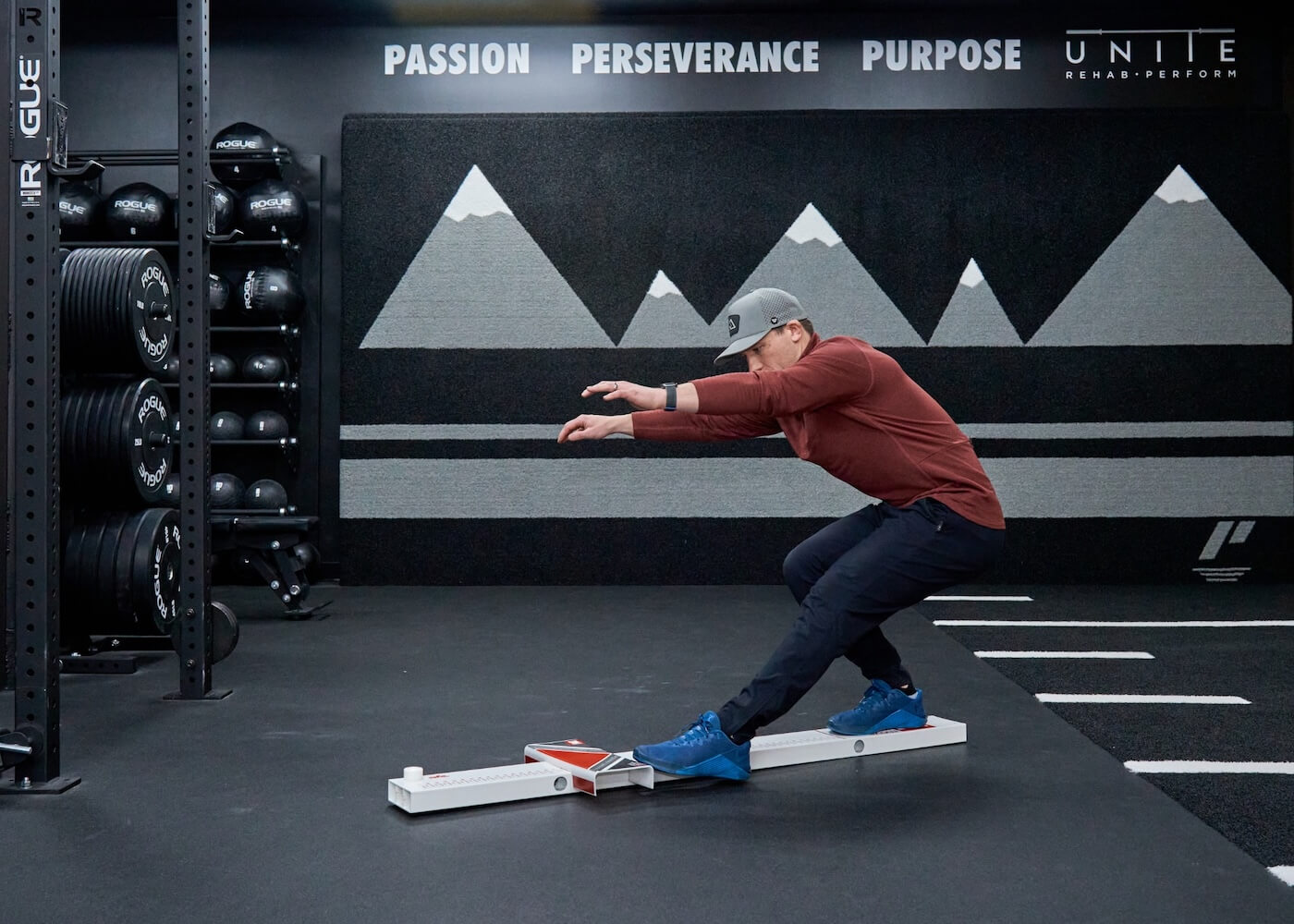
Eccentric training emphasizes the lowering phase of a movement, typically performed over 6 to 8 seconds. Exercises like step-downs are highly effective here because they place sustained, controlled tension on the tendon.
This type of loading stimulates the tendon’s repair process and helps it become stronger and more resilient over time. It is the bridge between pain management and genuine tissue adaptation.
Examples:
- – Slow step-downs
- – Controlled squats with emphasis on the lowering phase
Step 3: Improve Ankle Mobility to Reduce Knee Stress
Limited ankle mobility, particularly dorsiflexion, is a common but frequently overlooked contributor to knee pain.
When the ankle cannot move through its full range, the knee is forced to absorb more load during squatting, landing, and decelerating. Over time, that compensation increases stress directly on the patellar tendon.
Improving ankle mobility helps distribute force more efficiently through the entire kinetic chain and improves overall movement mechanics, not just at the knee.
Focus areas:
- – Ankle dorsiflexion mobility drills
- – Calf flexibility and soft tissue work
Taking It Further: How Physical Therapy Accelerates Recovery
These three steps are a strong starting point and will move most athletes in the right direction. Where the results either accelerate or stall is in the details: how much load to apply at each stage, when to progress, how to adjust when symptoms fluctuate, and how to bridge the gap between rehab and full sport demands. That is where professional guidance changes the outcome.
At UNITE, our approach includes:
Movement assessment: Identifying the specific movement patterns and compensations contributing to tendon overload, not just treating the symptomatic area in isolation.
Load management strategies: Determining exactly how much activity your tendon can currently tolerate and building a structured progression from there, rather than guessing.
Strength progression: Systematically advancing from isometrics to eccentrics to dynamic, sport-specific loading as the tendon’s capacity improves.
Return-to-sport testing: Confirming strength, symmetry, and jump mechanics meet the standard required before clearing an athlete to return to full training and competition.
When Can You Return to Sport?
Returning too early is one of the most common reasons patellar tendinopathy becomes a recurring issue rather than a resolved one. A few benchmarks worth tracking before returning to full activity:
Pain monitoring: Pain during and after activity should be minimal and not worsening session to session. Some mild discomfort during loading is normal in rehab, but it should not escalate.
Strength benchmarks: Quad strength on the affected side should be comparable to the unaffected side before returning to high-demand jumping and cutting activity.
Jumping progression: Athletes should progress through controlled jumping and landing drills before returning to unrestricted sport-specific jumping.
Performance testing: Jump height, landing mechanics, and single-leg control should be assessed and compared to baseline or to the uninvolved side.
Clearing the pain threshold alone is not enough. The tendon and the surrounding system need to be genuinely ready for the demands of sport, not just symptom-free at rest.
Frequently Asked Questions
Is jumper’s knee serious?
It can become a significant, long-term issue if ignored, but it is highly treatable with the right approach. The bigger risk is not the condition itself. It is athletes pushing through pain without addressing the underlying loading issue, which allows a manageable problem to become a chronic one.
Can I play sports with patellar tendinopathy?
In many cases, yes, with modifications. Mild cases often allow continued sport participation alongside a loading program, while more significant cases may require temporarily reducing high-impact activity to allow the tendon to rebuild capacity. This is highly individual and worth assessing with a professional rather than guessing.
Does patellar tendinopathy require surgery?
Rarely. The large majority of cases respond well to progressive loading and rehabilitation. Surgery is typically reserved for severe, long-standing cases that have not responded to a structured conservative approach over several months.
Can patellar tendinopathy come back?
Yes, particularly if an athlete returns to full training too quickly or the underlying contributors, like ankle mobility restrictions or strength deficits, were never fully addressed. This is exactly why return-to-sport testing matters. It is not just about pain being gone. It is about the tendon and surrounding system being genuinely ready for what your sport demands.
Ready to Get Back to Sport Without Knee Pain?
If jumping, sprinting, or training continues to aggravate your knee, the issue is rarely as simple as needing more rest. Our team can help identify the root cause of your symptoms and build a personalized recovery plan that gets you back to performing with confidence, not just back to pain-free.
Coach Francis, CSCS,
Coach Francis, CSCS, is a Strength and Performance Coach at UNITE.rehab.perform in Thornton, CO, specializing in youth athletic development, explosive power training, and long-term performance programming for athletes at every level.
Don’t leave it to chance.
Let Denver’s premier team of sports physical therapists and performance coaches lead the way!
©2020-2025 UNITE.rehab.perform LLC. All rights reserved.
UNITE.rehab.perform does not provide medical advice, diagnosis, or treatment through this website or related content. See additional information.