
UNITE.rehab.perform
Denver's Best Sports Physical Therapy
The Mid-Season Golf Performance Checkup: 5 Signs Your Body Is Costing You Distance
Dr. Victoria Riester, PT, DPT
Performance Physical Therapist, UNITE Rehab & Performance
Here are five things we look for when working with golfers whose game has plateaued or declined mid-season, and what each one means for your distance, consistency, and long-term durability on the course.
Why Swing Lessons Aren’t Always the Answer
Most golfers who lose distance go straight to the lesson tee. That makes sense. It is the most visible part of the problem. But a swing coach can only work with the range of motion, stability, and power your body actually has available.
If your hips cannot rotate, no amount of coaching will create separation that is not physically possible. If your thoracic spine is stiff, you cannot be coached into a bigger backswing your body will not allow.
This is why mobility and physical capacity have to be assessed before, or alongside, swing changes. It is also why we work directly with golf professionals and coaches. They handle the technical side. We handle whether your body can actually execute it.
Sign #1: Limited Hip Internal Rotation
Why it matters
The lead and trail hips need adequate rotation to create separation between the pelvis and torso. This is what allows you to create torque, which maximizes swing speed.
When hip rotation is limited:
- – Clubhead speed often decreases
- – Players lose consistency
- – The lower back compensates
Simple Self-Test
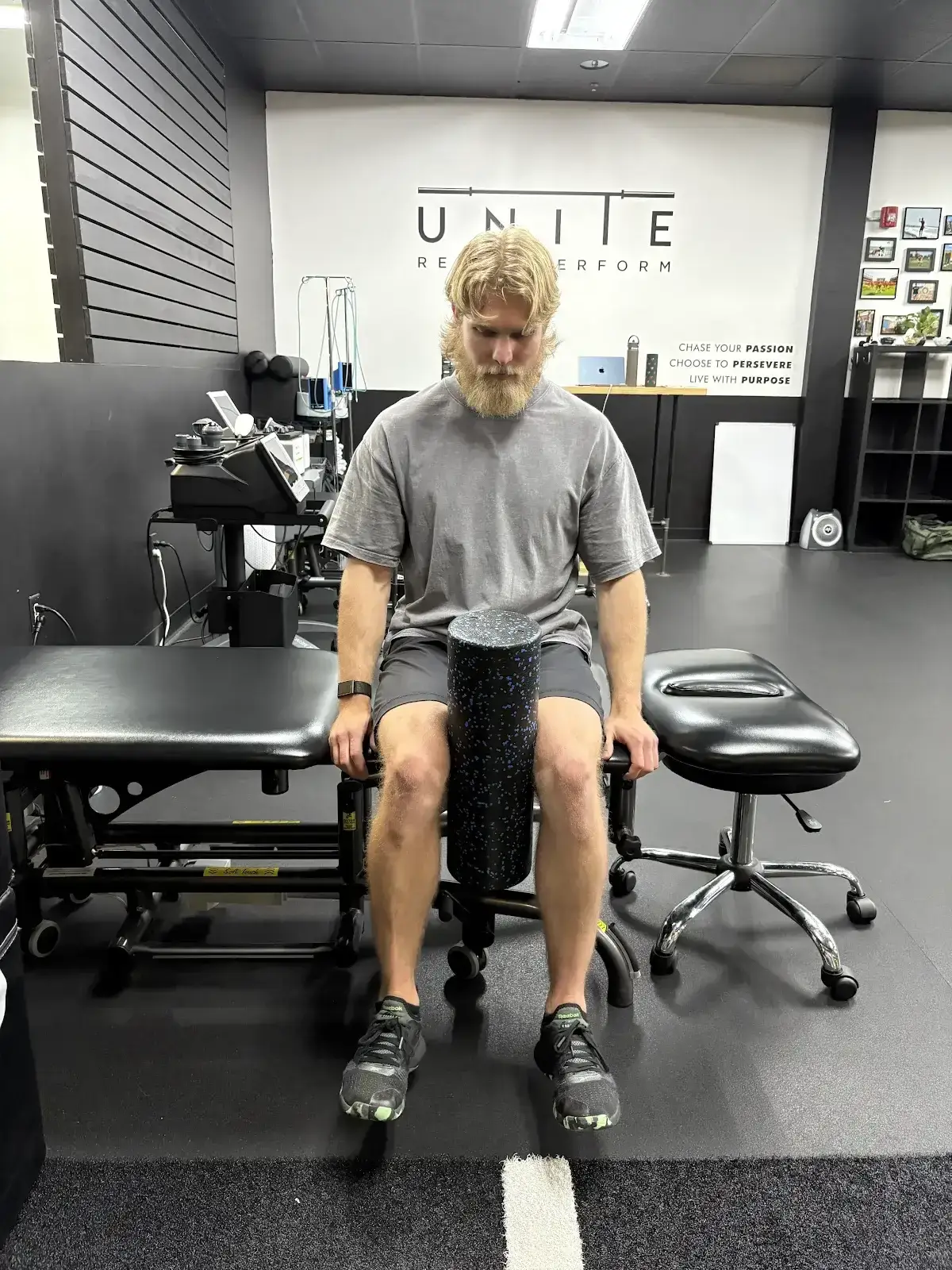
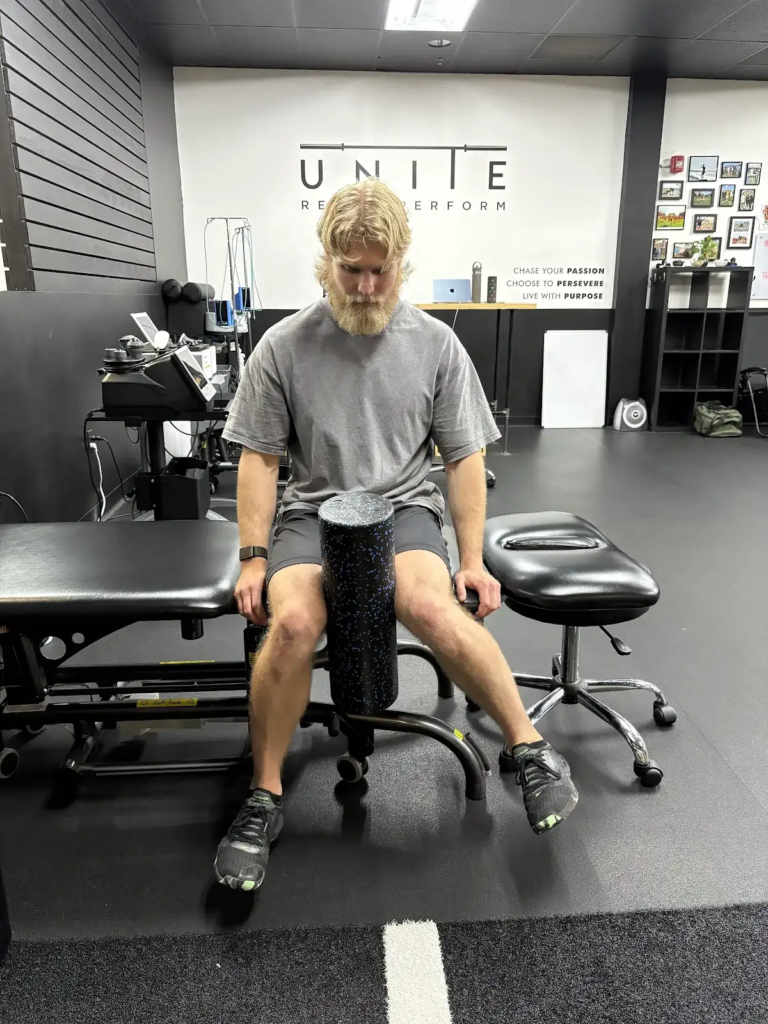
Sit with hips and knees at 90 degrees, hold something between your knees. Rotate your lower leg outward while keeping your thigh still.
What golfers notice
- – Difficulty making a full turn
- – Feeling “stuck” through impact
- – Early extension
Performance takeaway
If your hips can’t rotate, your body can’t efficiently create speed.
Sign #2: Poor Thoracic Rotation
Why it matters
The thoracic spine, the upper and middle part of your back, is responsible for much of the rotational movement in the golf swing. This allows you to reach your full backswing and finish your follow-through completely.
Limited thoracic mobility often results in:
- – Reduced shoulder turn
- – Less separation between the shoulders and hips
- – Lower clubhead speed
Simple Self-Test
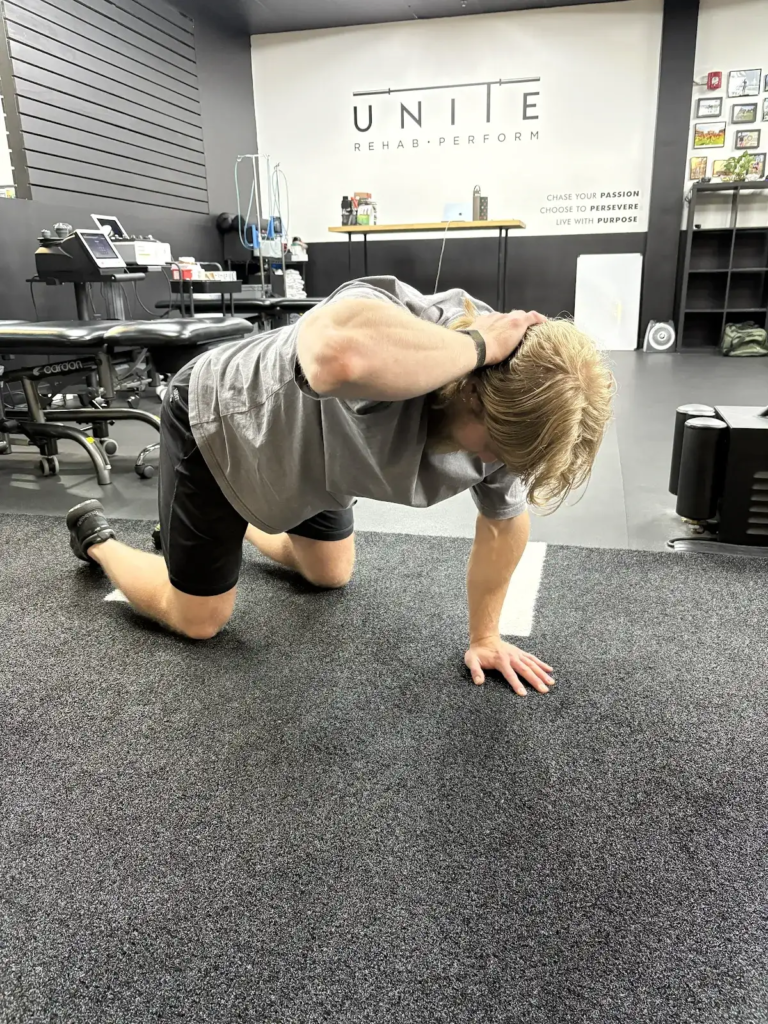
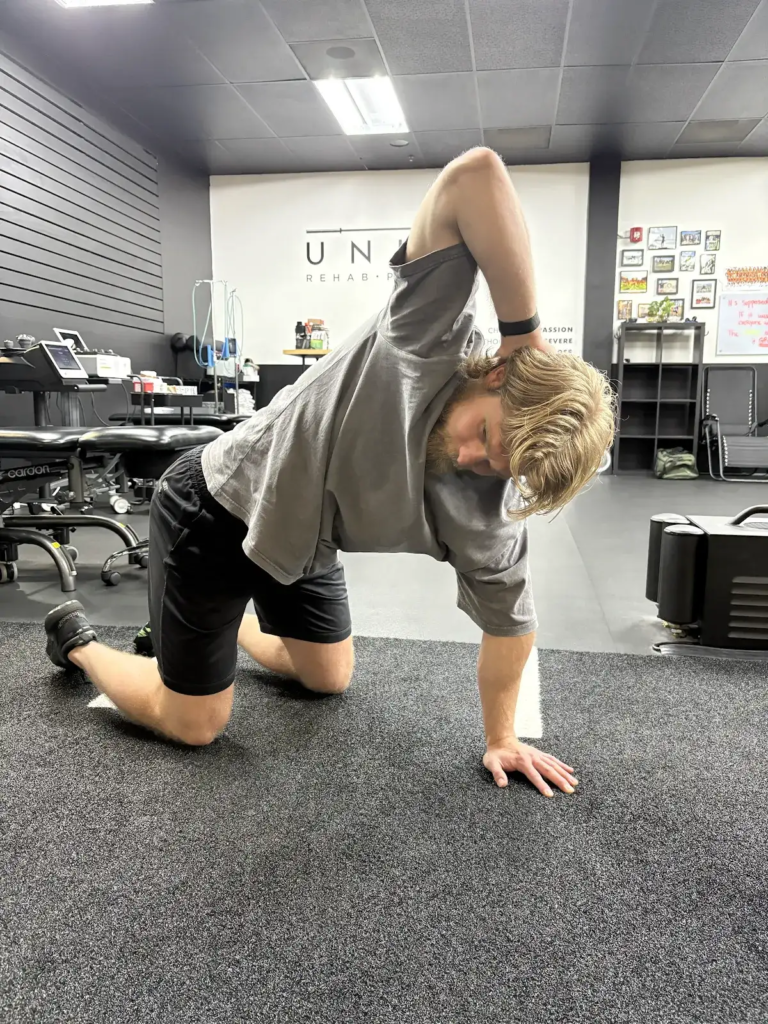
Assume a quadruped position. Place one hand behind your head and rotate your elbow toward the ceiling. Compare both sides.
What golfers notice
- – Short backswing
- – Difficulty finishing the swing
- – Feeling tight in the upper back
Performance takeaway
The more effectively your thoracic spine rotates, the easier it is to create a larger swing arc and generate speed.
Sign #3: Restricted Lead Ankle Mobility
Why it matters
Golfers often overlook the ankle. During the downswing, the lead leg must accept force and allow efficient weight transfer. Absorbing that force requires unrestricted ankle mobility.
Poor ankle mobility can:
- – Limit ground force production
- – Reduce stability
- – Affect balance through impact
Simple Self-Test
Perform a knee-to-wall test.
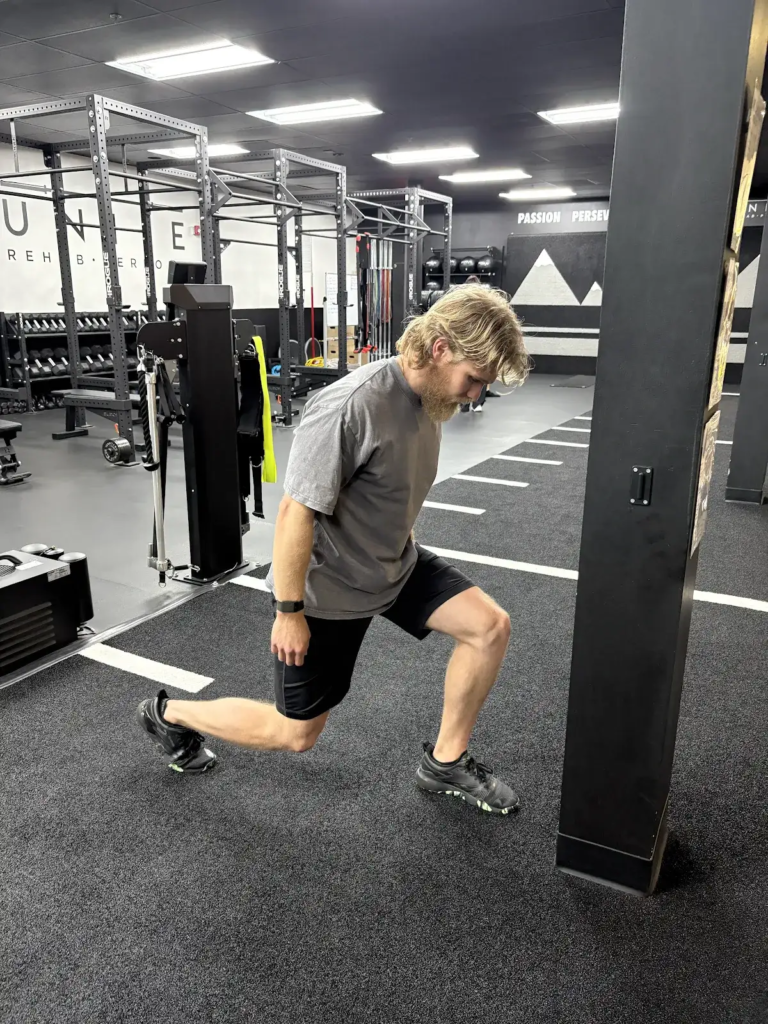
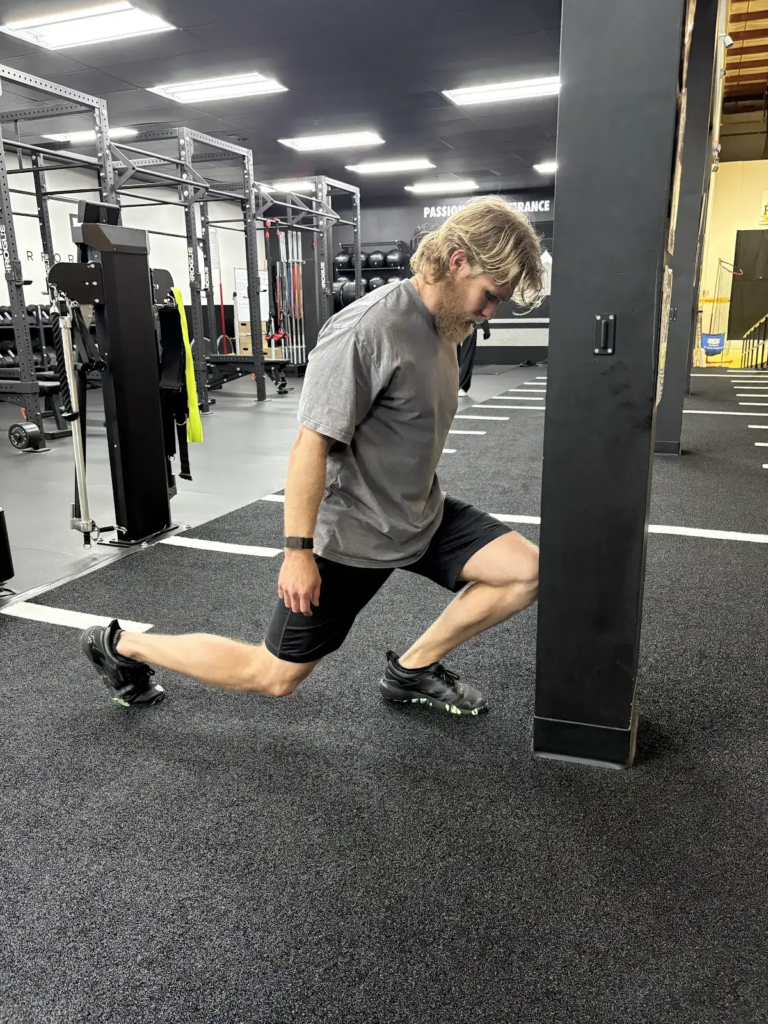
Can your knee touch the wall while your foot stays flat, approximately 4 to 5 inches away?
What golfers notice
- – Difficulty shifting weight
- – Loss of balance
- – Reduced power from the ground up
Performance takeaway
Distance starts from the ground. If your ankle doesn’t move well, force production suffers.
Sign #4: Poor Single-Leg Balance
Why it matters
Golf is a dynamic single-leg sport disguised as a two-legged sport. Throughout the swing, golfers repeatedly load and unload one side, which drives both force production and force absorption.
Simple Self-Test
Stand on one leg for 30 seconds. Then try with your eyes closed.
What golfers notice
- – Swaying during the swing
- – Inconsistent contact
- – Difficulty maintaining posture
Performance takeaway
Better balance creates a more stable platform for speed and accuracy.
Sign #5: Lack of Rotational Power
Why it matters
Mobility creates potential energy. Power turns that potential into speed. Many golfers move well but cannot rapidly produce force.
What golfers notice
- – Distance plateau
- – Strong technique but no speed gains
- – Fatigue late in rounds
Performance takeaway
Clubhead speed is a power skill, not just a mobility skill.
Common Injuries Tied to These Limitations
These same physical limitations do not just cap performance. Left unaddressed, they tend to show up as pain.
- – Low back pain, often from the spine compensating for limited hip or thoracic rotation
- – Golfer’s elbow, frequently linked to compensatory grip and forearm strain when the bigger joints do not rotate efficiently
- – Shoulder pain, common when thoracic stiffness forces the shoulder into a bigger range of motion than it is built for
- – Hip pain, often the direct result of repeated rotation through a joint that cannot access full range
If any of these sound familiar, the swing limitation and the pain are very likely connected.
What Happens During a Golf Performance Assessment
A golf performance assessment evaluates mobility, strength, balance, rotational control, and movement patterns to identify what is limiting swing efficiency, clubhead speed, and injury risk.
At UNITE, that looks like:
- – Mobility testing across the hips, thoracic spine, and ankles
- – Strength testing to identify imbalances between sides or muscle groups
- – Balance assessment using single-leg and dynamic stability testing
- – Power testing to see how efficiently you convert mobility into speed
- – A personalized plan built around what we actually find, not a generic golf fitness program
Exercises That Improve Golf Performance
The right exercises depend entirely on what your assessment finds. A golfer with restricted hips needs a different starting point than a golfer with strong mobility but low rotational power. In general, the categories that move the needle most are:
- – Hip mobility work, targeting internal rotation specifically
- – Thoracic rotation drills, to restore backswing depth and follow-through
- – Rotational power training, to convert available mobility into actual clubhead speed
- – Balance and single-leg stability training, to build a more consistent platform through impact
We will map out specifics once we know what your body actually needs. Guessing at exercises without an assessment is the same mistake as guessing at swing changes without one.
Quick Reference: Signs, Self-Tests, and What They Mean
Limitation | Self-Test | What It Costs You |
Limited hip internal rotation | Seated 90/90 rotation test | Reduced clubhead speed, lower back compensation |
Poor thoracic rotation | Quadruped rotation test | Shorter backswing, reduced shoulder turn |
Restricted lead ankle mobility | Knee-to-wall test | Poor weight transfer, reduced ground force |
Poor single-leg balance | 30-second single-leg stand, eyes open and closed | Inconsistent contact, swaying through the swing |
Lack of rotational power | Assessed during a performance evaluation | Distance plateau despite good mechanics |
So, How Do You Fix These?
These are five of the most common movement limitations we identify in golfers whose performance has plateaued or declined mid-season. Every one of them can be assessed and addressed.
At UNITE, we do not just look at your swing. We evaluate how your body moves to determine what is actually limiting your performance. Through a personalized golf performance assessment, we identify the mobility, stability, strength, and power deficits that may be costing you distance, consistency, or contributing to pain.
Golf is a highly technical sport, but it is also a highly physical one. If your body cannot access the positions your swing requires, no amount of swing changes will fully solve the problem. Our goal is to help you move better so you can swing faster, play longer, and perform at your highest level for the rest of the season.
FAQs
Should I stretch before golfing?
General stretching before a round has limited effect on the specific rotational mobility your swing requires. Targeted mobility work for the hips and thoracic spine, done consistently, matters far more than a few minutes of stretching before you tee off.
Is golf hard on your back?
Golf itself is not inherently hard on the back. Repeated rotation through hips or a thoracic spine that do not move well is what drives most golf-related back pain. Address the underlying mobility limitation and the strain on the low back typically resolves.
Can physical therapy actually improve my golf swing speed?
Yes. Golf-focused physical therapy can improve the mobility, stability, and power production that directly influence clubhead speed, on top of reducing pain and improving consistency.
Ready for a Mid-Season Performance Checkup?
If you have noticed a drop in distance, consistency, or feel like your body is holding your game back, schedule a golf performance assessment with our team. We will find out what is limiting your swing and build a plan to fix it before the season ends.
Dr. Victoria Riester, PT, DPT,
Dr. Victoria Riester, PT, DPT, is a Performance Physical Therapist at UNITE Rehab & Performance in Thornton, CO. A former competitive volleyball and cheerleading athlete, she specializes in helping active adults and golfers address the physical limitations behind pain and performance plateaus.
Don’t leave it to chance.
Let Denver’s premier team of sports physical therapists and performance coaches lead the way!
©2020-2025 UNITE.rehab.perform LLC. All rights reserved.
UNITE.rehab.perform does not provide medical advice, diagnosis, or treatment through this website or related content. See additional information.