

UNITE.rehab.perform
Denver's Best Sports Physical Therapy
Under Pressure: The Real Reason It's Harder to Breathe at Altitude
Written by Francis Huldi, MA, CSCS
Is There Less Oxygen at High Altitude?
A common misconception is that there’s less oxygen in the air at high elevations. Whether you’re standing on the summit of Mount Everest or tanning on a beach in Hawaii, the air contains the exact same concentration of gases: 21% oxygen, 78% nitrogen, and 1% trace gases. The real difference is atmospheric pressure.
What Atmospheric Pressure Has to Do With It
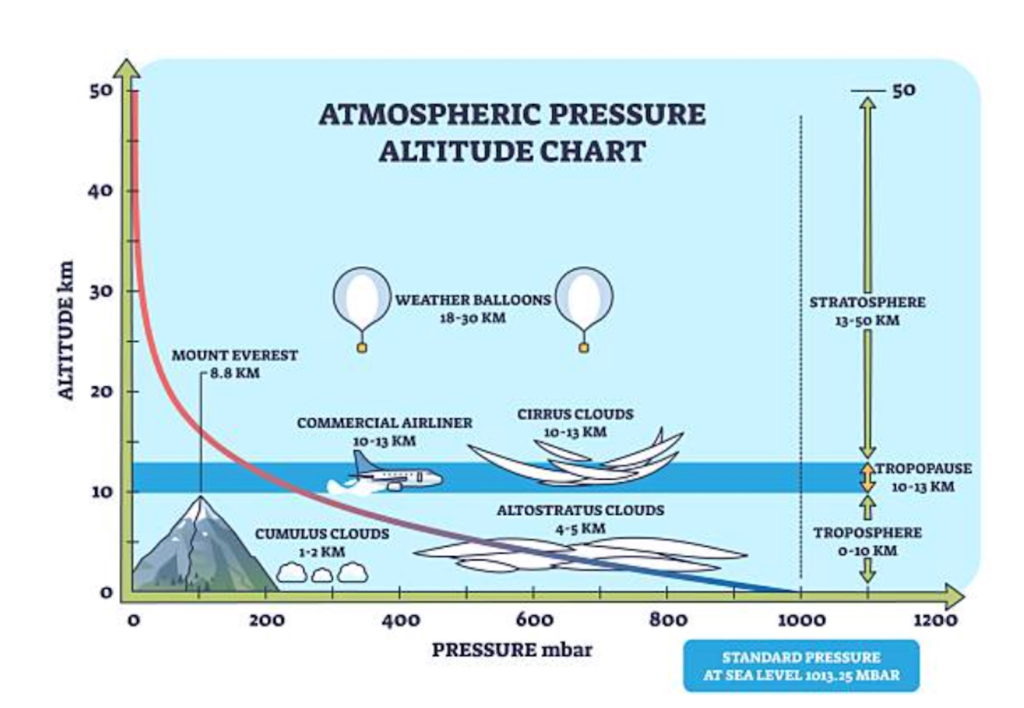
If you’ve ever dove to the bottom of a pool, you’ve likely felt pressure building up in your ears. The deeper you dive, the more water presses down on you, creating higher pressure. The same principle applies outside the water in our atmosphere. At sea level, you have the entire weight of the atmosphere pressing down on you. At the summit of Mount Everest (roughly 29,000 feet above sea level), there’s significantly less air stacked on top of you, resulting in much lower pressure.
Here’s how that plays out at a few familiar elevations:
Location | Oxygen in the Air | Air Pressure (vs. Sea Level) |
Sea level | 21% | 100% |
Denver (5,280 ft) | 21% | About 83% |
Colorado 14er summit (about 14,000 ft) | 21% | About 60% |
Mount Everest summit (about 29,000 ft) | 21% | About one-third |
How Your Lungs Pull Air In
So, if the oxygen concentration is the same everywhere, how does lower atmospheric pressure make breathing so much harder?
The next piece of the puzzle is understanding the mechanics of how air enters the lungs. When you inhale, your diaphragm moves downward and your rib cage lifts outward, expanding your chest cavity. As volume increases, the pressure inside your chest cavity decreases, a principle governed by Boyle’s Law, which states that gas pressure drops as volume increases. Because internal lung pressure drops below the outside air pressure, a gradient is created. Air naturally flows from high pressure to low pressure, so it rushes into your lungs. Exhaling works the exact same way in reverse: your breathing muscles relax, the chest cavity shrinks, internal pressure rises above outside pressure, and air flows back out.
Why Every Breath Delivers Less Oxygen at Altitude
When you put it all together, the problem at high altitude becomes clear. Your breathing muscles create about the same pressure difference whether you’re on a beach in Hawaii or on top of a 14er, so each breath still fills your lungs. The catch is that lower-pressure air is thinner. That same breath carries fewer oxygen molecules than it would at sea level.
There’s a second hit, too. Oxygen moves from the tiny air sacs in your lungs (the alveoli) into your blood because of a difference in the partial pressure of oxygen between the two. At altitude, the partial pressure of oxygen in your lungs is lower, so less oxygen makes it across to the hemoglobin waiting to carry it to your muscles. Physiologists call this hypobaric hypoxia, which simply means low oxygen in the body caused by low air pressure. So your body does the only thing it can. It breathes faster and deeper to make up the difference.
What is partial pressure of oxygen? Partial pressure of oxygen is the portion of total air pressure that comes from oxygen. It’s what actually drives oxygen from your lungs into your bloodstream, and it drops as you climb.
What This Means If You Live or Train in Denver
Denver sits at 5,280 feet, which is how it earned the name Mile High City. The air pressure here is roughly 17% lower than at sea level, so every breath you take on a run around Wash Park carries fewer oxygen molecules than the same breath on that beach in Hawaii. If you just moved here, that’s why a flight of stairs or an easy jog felt anything but easy your first few weeks. And when you head up a 14er, the pressure drops even further, so expect that effect to get a lot more noticeable.
Respect the Pressure Gradient
So the next time you find yourself huffing and puffing on a mountain trail, don’t blame a lack of oxygen. Blame the physics of atmospheric pressure. Your lungs are still doing their job, but without the atmosphere doing the heavy pushing, every breath takes a little extra grit.
The good news is that your body adapts over time. How long that takes, and what it means for your workouts, is its own story, so check out what altitude does to your athletic performance. In the meantime, a strong aerobic engine goes a long way in thin air, and hybrid endurance training is a great way to build one. Give your body time to acclimate, pace yourself, and respect the pressure gradient!
Key Takeaways
- — Mountain air is still 21% oxygen. The difference is the pressure behind it.
- — Lower pressure means every breath carries fewer oxygen molecules, and less of that oxygen makes it into your blood.
- — Your body makes up for it by breathing faster and harder, which is the huffing and puffing you feel on the trail.
- — In Denver, air pressure is about 17% lower than at sea level, so give your body time to adapt and pace yourself.
Train for the Mountains With UNITE
Training for a 14er or a mountain race? Or did you just move to Denver and you’re feeling every flight of stairs? Our coaches can help you build the aerobic base altitude demands, whether that’s through hybrid endurance training or one-on-one performance training. Book a free movement assessment to get started.
Frequently Asked Questions
Is there less oxygen at high altitude?
Not in the way most people think. The percentage stays at about 21% from the beach to the summit of Everest. What you’re actually short on is oxygen molecules per breath, because lower pressure spreads the same air out over more space. It’s why most climbers on Everest use supplemental oxygen, even though the air up there is still 21% oxygen.
Why do I get out of breath faster in Denver or the mountains?
Each breath at altitude delivers less oxygen to your blood, so your body breathes faster and deeper to keep up. That extra work is why familiar workouts, hikes, or even stairs feel harder than they would at sea level.
How much lower is the air pressure in Denver?
At 5,280 feet, Denver’s air pressure is roughly 17% lower than at sea level, or about 83% of what you’d experience on the coast.
What is partial pressure of oxygen?
Multiply total air pressure by oxygen’s 21% share and you get the partial pressure of oxygen. At sea level, that works out to about 159 mmHg. In Denver, it’s closer to 132 mmHg, and on the summit of Everest it’s roughly 53 mmHg. That number, not the percentage, is what determines how easily oxygen moves into your blood.
Does it get easier to breathe at altitude over time?
Yes. Your body gradually adapts to lower pressure through a process called acclimatization. For timelines and how to adjust your training along the way, read what altitude does to your athletic performance.
UNITE.rehab.perform
Don’t leave it to chance.
Let Denver’s premier team of sports physical therapists and performance coaches lead the way!
©2020-2025 UNITE.rehab.perform LLC. All rights reserved.
UNITE.rehab.perform does not provide medical advice, diagnosis, or treatment through this website or related content. See additional information.