UNITE.rehab.perform
Denver's Best Sports Physical Therapy
What Is the Missing Piece to Better Performance and Fewer Injuries as a Gymnast?
Gymnastics demands an uncommon combination of qualities. Athletes must be powerful yet precise, flexible yet controlled, explosive yet composed. Every skill requires the ability to generate force, manage it in the air, and absorb it safely on landing — often hundreds of times per week.
And yet, one of the most impactful pieces of long-term success is still widely misunderstood: strength training for gymnasts.
Not random conditioning circuits.
Not endless skill repetition.
Intentional, well-designed strength training that supports how gymnasts actually move.
When done correctly, strength training is not just safe for gymnasts. It is one of the most effective ways to improve performance, reduce injury risk, and build confidence through growth, training volume, and competition.
Let’s break down why it matters so much.
Gymnasts Need Strength to Create and Control Power
Every gymnastics skill is a conversation between force and control. Vaults, tumbling passes, bar releases, handstands, leaps, and dismounts all require explosive power paired with exceptional body awareness.
Strength training supports:
– Lower body power for higher jumps and more efficient tumbling
– Upper body strength for bars, vault, rings, and weight-bearing skills
– Core strength to maintain body shapes during flight, rotation, and landings
Stronger gymnasts do not just produce more power. They control it better. That control shows up as cleaner skills, more consistency, and fewer breakdowns as practice intensity rises.
How Strength Training Reduces Injury Risk in Gymnastics
Gymnastics carries one of the highest overuse injury rates in youth sports. In the clinic, we most often see:
– Wrist pain
– Shoulder irritation or instability
– Ankle sprains
– Hip flexor and adductor strains
Contrary to popular belief, these injuries are rarely caused by a lack of flexibility. More often, they stem from poor load tolerance, strength asymmetries, and joints absorbing forces they were never trained to handle.
Strength training helps by:
– Building joint and tendon resilience
– Improving landing mechanics and force absorption
– Addressing right-to-left imbalances
– Increasing an athlete’s capacity to tolerate training volume
When gymnasts are stronger, they are not just harder to injure, they recover better between practices and competitions.
Stronger Gymnasts Learn Skills Faster
Strength is the foundation that allows skills to stick.
When a gymnast can:
– Maintain full-body tension
– Control scapular and shoulder positioning
– Stabilize the pelvis and trunk
– Produce consistent force through the upper and lower body
Skill acquisition accelerates.
Strength training supports:
– More effective shoulder blocks in tumbling
– Increased power and control during vault approaches
– Safer, more efficient bar transitions
– Higher leaps and more stable landings
When the body is capable of supporting the skill, confidence grows and hesitation fades.
Strength Training Will Not Make Gymnasts Bulky
This is one of the most persistent myths in gymnastics.
Gymnasts who strength train appropriately:
– Build lean, efficient muscle
– Improve their power-to-weight ratio
– Move more efficiently
– Fatigue less during long practices
Because gymnastics already demands high volume and technical precision, strength training enhances performance without adding unnecessary mass. It improves how athletes use their bodies rather than changing their physique.
Strength Training Improves Flexibility the Right Way
True flexibility is not passive. It is controlled range of motion.
Examples:
– Strong hip flexors and glutes support deeper, safer splits and leaps
– Strong shoulders allow stable overhead positions on bars
– Strong core control reduces excessive stress on the low back
Strength combined with mobility creates usable flexibility. This is how gymnasts avoid the common cycle of stretching more, still feeling tight, and eventually getting hurt.
Stronger Gymnasts Compete With More Confidence
Confidence is not just mental — it is physical.
When gymnasts trust their bodies, they:
– Commit fully to skills
– Stick landings more consistently
– Control momentum in the air
– Handle pressure with greater composure
Strength training builds the physical assurance athletes need to perform when it matters most.
How Much Strength Training Do Gymnasts Need?
For most gymnasts, two to three focused strength sessions per week is ideal.
Effective gymnastics strength training includes:
– Core stability and anti-rotation work
– Hip and glute strengthening
– Scapular stability and shoulder control
– Wrist and forearm load tolerance
– Plyometrics and power development
– Full-body movement patterns such as hinges, squats, pushes, and pulls
The goal is not to train like a bodybuilder. The goal is to build a resilient, capable athlete who can tolerate the demands of the sport.
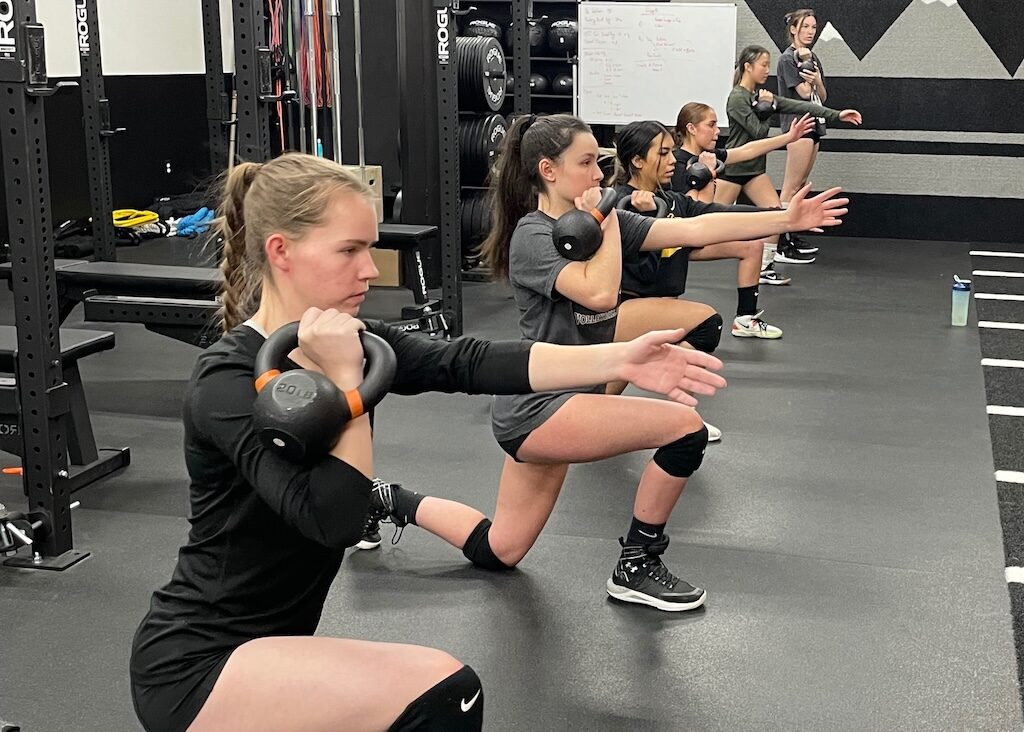
Three Kettlebell Exercises We Use for Gymnasts With Upper Body Pain
If wrist pain, shoulder irritation, or upper back stiffness are holding you back, these are three exercises we regularly use to improve stability and protect the joints gymnasts rely on most.
Half Kneeling Kettlebell Windmill
This drill improves shoulder stability, thoracic mobility, and core control. Strong shoulders and trunk control allow gymnasts to maintain tight shapes during tumbling, beam work, and landings.
Single Arm Single Leg Kettlebell Row
This builds pulling strength while reinforcing proper scapular positioning. Pulling strength is essential for bars, where force must be both generated and absorbed safely.
Bottoms Up Kettlebell Carry
One of the most effective drills for shoulder and wrist stability. It teaches the shoulder to distribute force appropriately so smaller joints like the wrist and elbow are not overloaded.
The Bottom Line
Strength training for gymnasts is not optional if the goal is long-term performance, consistency, and health.
The strongest gymnasts are not just the most powerful. They are the most resilient, confident, and durable.
As a sports and performance physical therapist who was a gymnast for over a decade, I can say this with confidence: the gymnasts who train for strength stay healthier and progress further.
If you want expert guidance from a team that understands gymnastics from the inside out, UNITE.Rehab.Perform specializes in strength training, injury prevention, and performance physical therapy for gymnasts. Schedule a gymnastics-specific movement assessment, and let’s build a plan that keeps you strong, confident, and competing at your best.
©2020-2025 UNITE.rehab.perform LLC. All rights reserved.
UNITE.rehab.perform does not provide medical advice, diagnosis, or treatment through this website or related content. See additional information.