UNITE.rehab.perform
Denver's Best Sports Physical Therapy
Dry Needling for Athletes: What It Is, How It Works, and Why It Matters
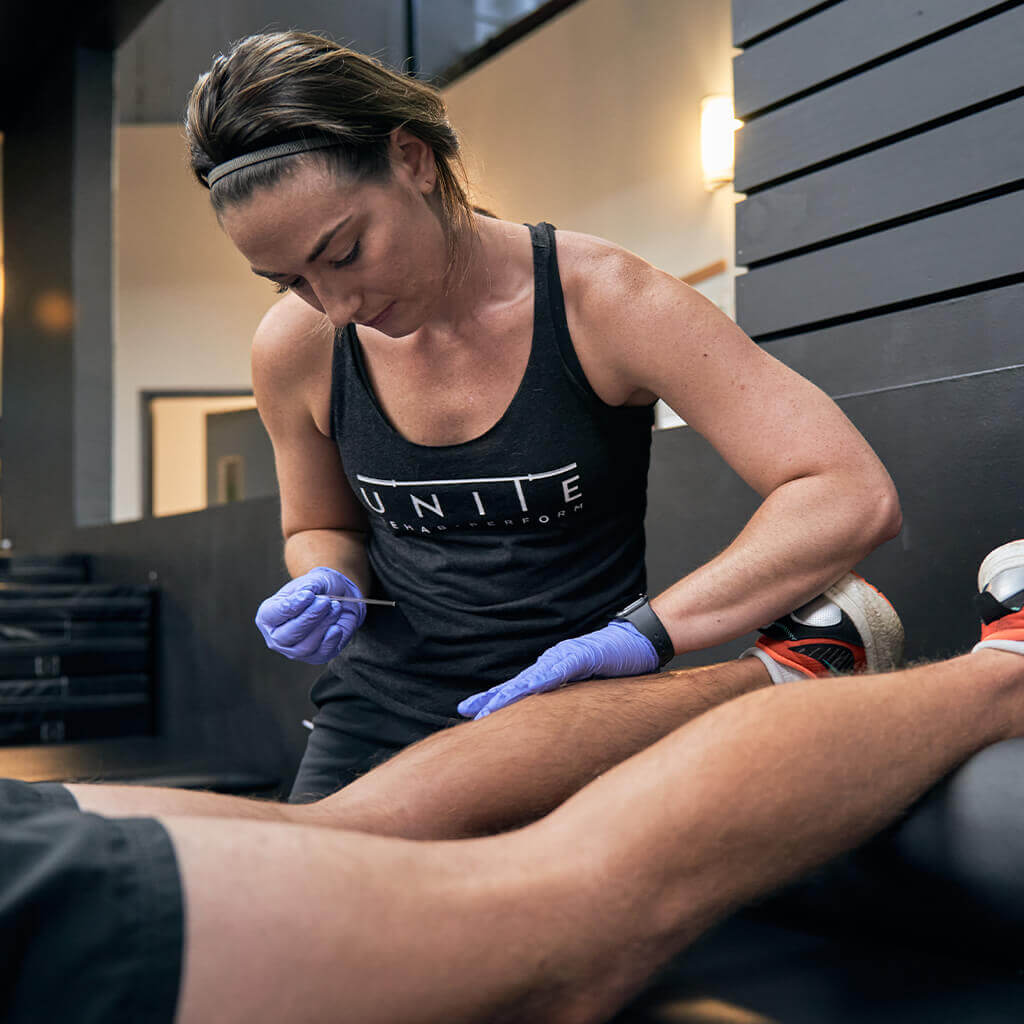
If you train consistently, lift heavy, run fast, or compete with any level of intensity, you already know what it feels like when something in your body refuses to loosen up. Maybe it is a tight hip that keeps coming back. Maybe it is a shoulder that feels fine one day and locked the next. Maybe it is a knot in your calf or upper back that laughs at foam rollers.
This is where dry needling for athletes becomes a game-changer. We use it every day at UNITE.rehab.perform to help people break through the tension, pain, and movement limitations that hold their training back.
Not everyone understands what dry needling actually does, so let’s walk through it in a clear, real-world way. No fluff, no mystery, just what you need to know as an athlete.
What Dry Needling Really Is
Dry needling is a technique performed by licensed physical therapists using a thin, sterile needle to target irritated or dysfunctional muscle, tendon, ligament, or connective tissue. It is not acupuncture. It is based on orthopedic and neurological science and is designed to influence how your tissue behaves and how your nervous system responds.
The goal is straightforward.
- — Decrease pain
- — Reduce tension
- — Improve mobility
- — Speed up recovery
- — Help you move and perform with more efficiency
Athletes train hard, and hard training creates stress. Dry needling helps your tissue normalize so you can keep progressing without nagging limitations slowing you down.
Why Athletes Use Dry Needling
Faster Recovery
Heavy training creates micro-irritation in the tissue. Dry needling helps clear it faster by releasing muscular tension and improving circulation. Your body repairs more efficiently when the tissue is not guarded or overloaded.
Better Mobility
When a muscle guards or stays tight, mobility restrictions follow. Needling helps reset the muscle so the joint can actually move. This is huge for overhead athletes, runners, lifters, and rotational sport athletes.
Pain Relief
Dry needling influences the nervous system in a way that reduces pain signals and relaxes protective tension. Athletes often describe it as a pressure release that finally lets them move without restriction.
Improved Performance
When you move with more freedom and less irritation, positions get cleaner and your power output improves. Needling does not replace training, but it helps unlock the quality of movement your training depends on.
The Science: How Dry Needling Works

Dry needling creates a tiny, controlled micro-injury in the tissue. This is intentional. It triggers several beneficial physiological effects.
Your body releases natural pain relievers
The needle stimulates the production of internal pain-regulating chemicals, including compounds like anandamide. This helps reduce discomfort and calm irritation in the tissue.
Local inflammation gets reset
In many chronic injuries, tissue gets stuck in a poor healing phase. Needling triggers a short, localized inflammatory response that gives your body a new opportunity to repair the area correctly.
Blood flow increases
Vasodilation, which is the widening of blood vessels, brings more oxygen and nutrients to the tissue. It also helps flush out metabolic waste that contributes to soreness or guarding.
Pain signals decrease
Dry needling activates specific nerve fibers that influence how your brain interprets pain. This can reduce sensitivity for up to 72 hours and allows us to retrain movement patterns without the body fighting back.
Tissue healing improves
Fibroblasts, the cells responsible for repairing connective tissue, become more active. Over time, this supports healthier tissue quality and helps restore normal function.
Dry Needling vs Acupuncture
This comes up often, so here is the simple explanation.
Acupuncture is based on traditional Eastern medicine and focuses on energy pathways.
Dry needling is based on musculoskeletal science and focuses on restoring function in specific tissues.
The tools look similar, but the reasoning, assessment, and goals are completely different.
How Long Results Last
Athletes often feel relief right after treatment. Some notice changes for several hours, others for several days. What matters most is what the reduction in pain or tension allows us to do next.
Dry needling opens the window. Physical therapy and strength training keep it open by fixing the pattern that caused the problem in the first place.
The Bottom Line
Dry needling is not a magic button, but it is a powerful tool backed by strong physiological mechanisms. It helps you move with less pain, restore mobility, and create a better environment for healing.
For athletes, this means fewer limitations, faster progress, and a clearer path back to high-quality training.
If you are dealing with stubborn tightness, irritation that keeps coming back, or pain that limits your performance, dry needling may be exactly what your body needs to reset and recover.
Ready to See Whether Dry Needling Can Help You Train Better?
If you want a clear plan that blends dry needling with sports physical therapy, movement analysis, and strength progression, the team at UNITE.rehab.perform in Thornton, CO, is ready to help you move with confidence again.
Ready to see what dry needling can do for your training and recovery? Book a session with UNITE.rehab.perform and get a performance-driven plan tailored to your body.
©2020-2025 UNITE.rehab.perform LLC. All rights reserved.
UNITE.rehab.perform does not provide medical advice, diagnosis, or treatment through this website or related content. See additional information.