UNITE.rehab.perform
Denver's Best Sports Physical Therapy
Strength Training: The Missing Link to Your Gymnastics Performance
UNITE.rehab.perform
So, should gymnasts lift weights? Yes. Resistance training complements gymnastics-specific strength by developing general force production, force absorption, tissue capacity, and power. The goal isn’t to add unnecessary muscle mass. It’s to build the strength and durability a gymnast’s body needs to keep meeting the demands their sport keeps raising.
There’s still a common belief in the gym world that gymnasts only need bodyweight work, and that lifting will make them bulky, less flexible, or somehow worse at their sport. We hear this from parents constantly, and it’s worth saying plainly: that belief doesn’t hold up. Strength training, done right, makes gymnasts better prepared for exactly what their sport demands of them.
Why Should Gymnasts Strength Train?
Gymnastics builds real strength. Nobody doubts that a gymnast holding an iron cross or sticking a double back has serious strength. But that strength is built in very specific positions and patterns, the exact ones their skills require, and not much beyond that.
A gymnast can be extraordinarily strong at a particular skill and still lack the general strength and tissue capacity to hold up under the sheer repetition of training. Hundreds of landings a week. Thousands of reps a season. That volume adds up regardless of how strong any single skill looks. This is the gap strength training exists to close, and it’s a gap that gymnastics alone, no matter how hard the athlete trains, doesn’t fully address.
Gymnastics Is Already Strength Training. So Why Add Weights?
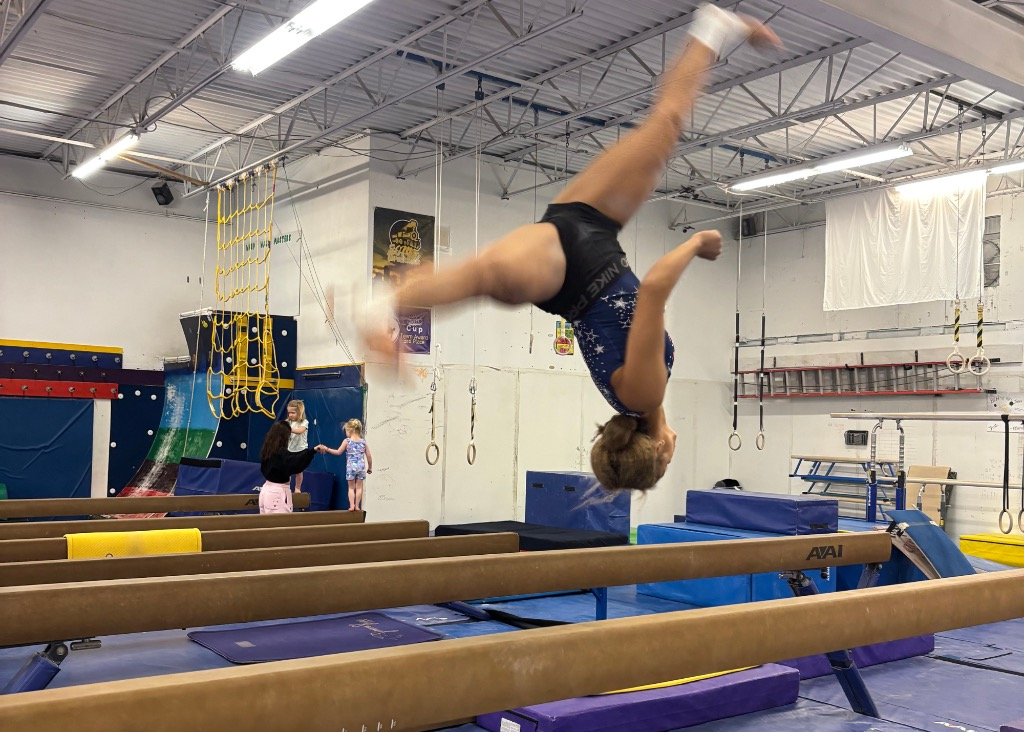
Pull-ups, handstands, rope climbs, presses, leg lifts, jumps, tumbling, holds. In a lot of ways, gymnastics already is a strength sport, and one of the most demanding ones out there.
But that strength is narrow by design. A gymnast’s body adapts precisely to the positions and loads gymnastics puts on it, which is exactly what makes an elite skill possible, and exactly why it doesn’t transfer well beyond that skill. Squats, deadlifts, split squats, rows, presses, and loaded carries expose the body to controlled resistance outside those specific patterns. That gives muscles, tendons, bones, and connective tissue a chance to adapt in a broader, more well-rounded way than gymnastics training alone provides.
The goal isn’t to replace gymnastics strength. It’s to build the foundation underneath it.
Can Strength Training Make a Gymnast Bulky?
This is the concern we hear most, and it’s worth answering directly: no, not when the program is built for a gymnast.
Meaningful muscle growth requires a specific combination of training volume, caloric surplus, and hypertrophy-focused programming, sustained over time. That combination almost never shows up in a well-designed gymnastics strength program, and it’s nowhere close to what most gymnasts are already doing between practice hours and competition season. How an athlete’s body actually adapts comes down to exercise selection, intensity, volume, nutrition, and the structure of the program itself, not the simple fact that weights were involved.
For a gymnast, the goal was never bodybuilding. It’s strength-to-weight ratio, force production, power, and control. A gymnast doesn’t need to train like a bodybuilder. They need to train like a gymnast who also happens to lift.
Can Weight Training Affect Flexibility?
Here’s something most conversations about gymnastics and strength training miss entirely: a large number of gymnasts are naturally hypermobile. Their joints move through a greater range of motion than the average person’s, often well beyond what’s needed for a split or a bridge.
That flexibility is an asset. It’s also, without the right support, a liability. A joint that moves further than it is stable is a joint working with less control at its end ranges, exactly where landings, dismounts, and hyperextension-heavy skills like back walkovers and giants place the most stress. Strength training doesn’t take flexibility away. Done well, through full and controlled ranges of motion, like a deep squat or a well-executed overhead press, it builds the stability that a naturally flexible joint often doesn’t have on its own.
The real question for a hypermobile gymnast usually isn’t “will lifting make me stiff.” It’s “does my strength match my flexibility.” For a lot of gymnasts, it doesn’t yet. That mismatch, not the weight room, is usually what’s actually driving the risk.
How Strength Training Builds a More Resilient Gymnast
The wrists, elbows, shoulders, spine, hips, knees, and ankles all take on serious repeated force during tumbling, vaulting, bars, and landings. When what training demands consistently outpaces what an athlete’s body can currently handle, overuse injury risk climbs.
Strength training exists to narrow that gap. It supports a gymnast’s ability to:
- – Produce force
- – Absorb force
- – Control landing mechanics
- – Hold body positions under fatigue
- – Tolerate repetitive loading
- – Generate explosive power
- – Build stronger muscles, tendons, and bones
No program guarantees an injury-free season. What a well-built strength program does is give an athlete more room between what their sport is asking of them and what their body can currently take on, and that room matters more with every level they move up.
What Should Gymnasts Strength Train?
A complete program combines gymnastics-specific strength with general athletic development. Here’s what that actually looks like on the floor of a weight room, and why each piece earns its place.
Lower Body
Squats, split squats, deadlifts, lunges, jumps, and landing mechanics. This is where the raw force production and landing control behind every vault, tumbling pass, and dismount actually gets built.
Upper Body
Pull-ups, rows, presses, push-ups, and controlled overhead work. Bars alone demand more from the shoulders and upper back than most sports ask of any joint, and general upper body strength gives that system more to draw from.
Core
Anti-extension, anti-rotation, carries, trunk control, and gymnastics-specific body positions. This is what lets a gymnast hold a hollow body position or a tight arch under fatigue, at the end of a routine, not just the beginning.
Power
Jumping, throwing, sprinting, and other explosive movements at appropriate volume. Power is what turns raw strength into the speed off the floor or the block off the vault table that actually shows up in competition.
Gymnastics-Specific Strength
Handstands, presses, rope climbs, leg lifts, body tension, shaping drills, skill-specific strength. This piece never disappears from the program. General strength training supports it. It doesn’t replace it.
The question was never gymnastics strength versus weightlifting. The best programs never made that a choice in the first place.
How Much Strength Training Do Gymnasts Need?
There’s no single number here, and that’s not a dodge, it’s the honest answer. A recreational Xcel gymnast working on their first back handspring and a Level 10 gymnast training a full-twisting Yurchenko vault are carrying completely different training loads, recovery demands, and physical maturity. Their strength programming shouldn’t look the same either.
One mistake we see often: assuming more conditioning always helps. Gymnasts already accumulate enormous training volume through the sport itself. Stacking endless push-ups, sit-ups, jumps, and holds on top of that isn’t automatically the answer, and it can just as easily pile on fatigue without building any real capacity.
What actually works is intentional and progressive: the right exercises, the right volume, and enough recovery for the athlete’s body to actually adapt to what it’s being asked to do. More isn’t the goal. Smart, individualized programming is, and that looks different for every gymnast in the gym.
Train for the Sport You Want to Perform
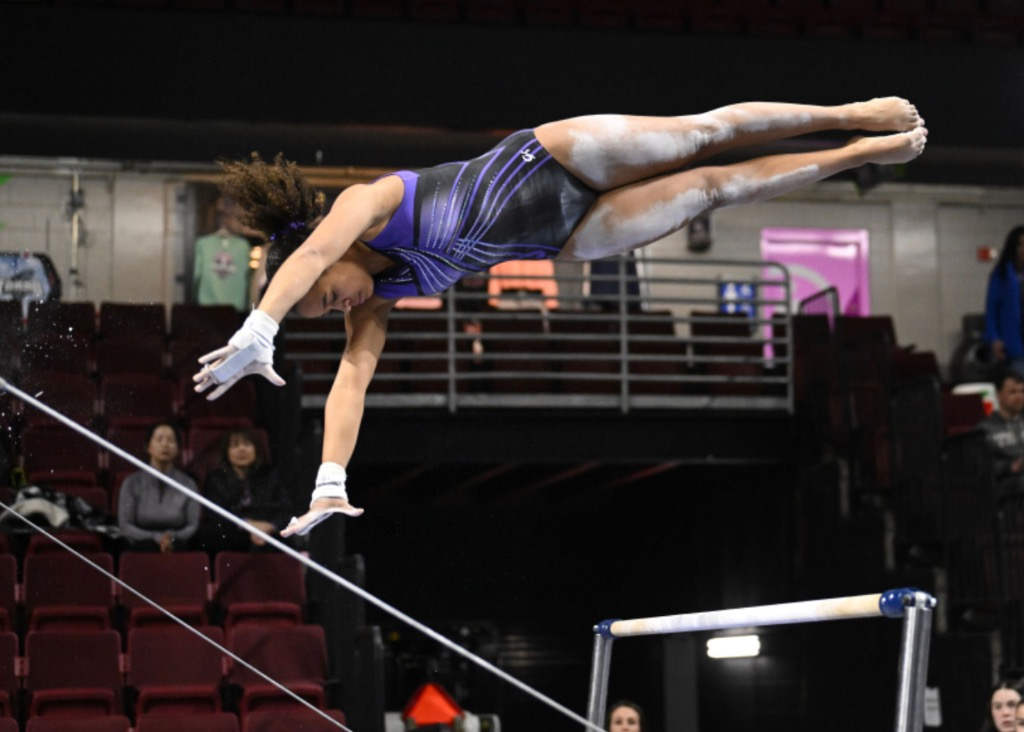
Gymnastics isn’t getting less demanding. Skills are getting harder, training volumes are climbing, and athletes are specializing younger than ever. The ability to repeatedly produce and absorb force isn’t just about the next meet. It’s what determines whether an athlete is still competing, and still healthy, years from now.
Strength training was never about making gymnasts bigger. It’s about making them stronger, more powerful, and genuinely prepared for what their sport asks of them.
At UNITE, we believe strength training should complement gymnastics, not compete with it. The goal is simple: build an athlete who can handle what gymnastics demands today, and who is still standing on the mat, healthy and performing, years from now.
Key Takeaways
- – Gymnastics already builds real strength, but in narrow, skill-specific patterns that don’t cover everything an athlete’s body needs.
- – Resistance training complements gymnastics-specific strength. It was never meant to replace it.
- – A properly programmed lifting routine does not automatically add bulk.
- – Many gymnasts are naturally hypermobile, which makes building stability through strength training more important, not less.
- – The goal is strength-to-weight ratio and performance, not bodybuilding.
- – Programming should reflect the individual gymnast’s age, level, training volume, and recovery, not a single template applied to everyone.
FAQs
Should gymnasts lift weights?
Yes, when the program is built specifically for a gymnast’s body and sport. Resistance training fills in the general force production, force absorption, and durability that gymnastics-specific training alone doesn’t fully build.
Does lifting weights make gymnasts bulky?
Not when the program is designed correctly. Meaningful muscle growth requires a specific combination of volume, intensity, and nutrition that most gymnastics strength programs simply aren’t built around. The focus stays on strength-to-weight ratio and power, not size.
What age should gymnasts start strength training?
There’s no single starting age that applies to every athlete. What matters more than a specific number is that the program matches the gymnast’s physical maturity, current skill level, and training volume, with an emphasis on movement quality and technique before adding meaningful load.
Does strength training stunt growth in young gymnasts?
No. This is one of the most persistent myths in youth sports, and it isn’t supported by the evidence. Properly programmed, age-appropriate strength training is safe for young athletes and doesn’t affect growth plates or long-term height. For a deeper look at where this myth comes from, read our full breakdown here.
Written by Dr. Lauren, DPT
Dr. Lauren Culp, PT, DPT, Cert-DN, VRS, is a Performance Physical Therapist at UNITE Rehab & Performance. A former competitive gymnast herself, she brings a rare combination of firsthand experience and clinical expertise to how she trains and treats gymnasts, understanding both the demands of the sport and the science behind building strength that actually holds up under them.
Don’t leave it to chance.
Let Denver’s premier team of sports physical therapists and performance coaches lead the way!
©2020-2025 UNITE.rehab.perform LLC. All rights reserved.
UNITE.rehab.perform does not provide medical advice, diagnosis, or treatment through this website or related content. See additional information.