Close

French Contrast Training for Vertical Jump: Add 3–5 Inches With This 4-Step Method

Written by Coach Francis, CSCS

If you’re looking for how to increase your vertical jump, French Contrast training is one of the most effective methods available and one of the most underused.

French Contrast is a proven power-training method that pairs a heavy strength movement with progressively faster power exercises. The goal is to take advantage of a real performance effect: after you move a heavy load with maximum effort, your nervous system becomes “primed,” allowing you to produce more force and speed on the explosive movements that follow.

In other words: heavy strength → faster jumps → higher vertical.

This isn’t a general fitness program. It’s a targeted vertical jump training program built around one principle — training your nervous system to express force faster. Below is a simple French Contrast framework you can use to target 3–5 inches of vertical jump improvement over time with consistent training and smart progression.

Who This Is For

French Contrast training is a strong fit for:

  • — Basketball and volleyball players looking to add serious inches to their vertical
  • — Field sport athletes (soccer, football, rugby) who need explosive first-step power
  • — Lifters who have built a solid strength base but hit a vertical jump plateau
  • — Serious athletes with at least a few months of strength training experience under their belt

If you’re a beginner, scroll down to the modification section before jumping in.

What Is French Contrast Training?

French Contrast Training is a 4-step power training method that combines heavy strength exercises with explosive plyometrics to improve vertical jump and athletic performance.

It’s a 4-exercise sequence performed back-to-back with moderate rest, repeated for multiple sets. You start with the heaviest, slowest movement and progress toward the lightest and fastest. This creates a powerful stimulus for the nervous system to improve rate of force development, efficiency, and explosive output — exactly what drives vertical jump performance.

French Contrast is commonly used for:

  • — Vertical jump training
  • — Sprint speed development
  • — Explosive power for court and field athletes

The French Contrast Vertical Jump Sequence (4 Steps)

Perform the following sequence for 3–5 sets.

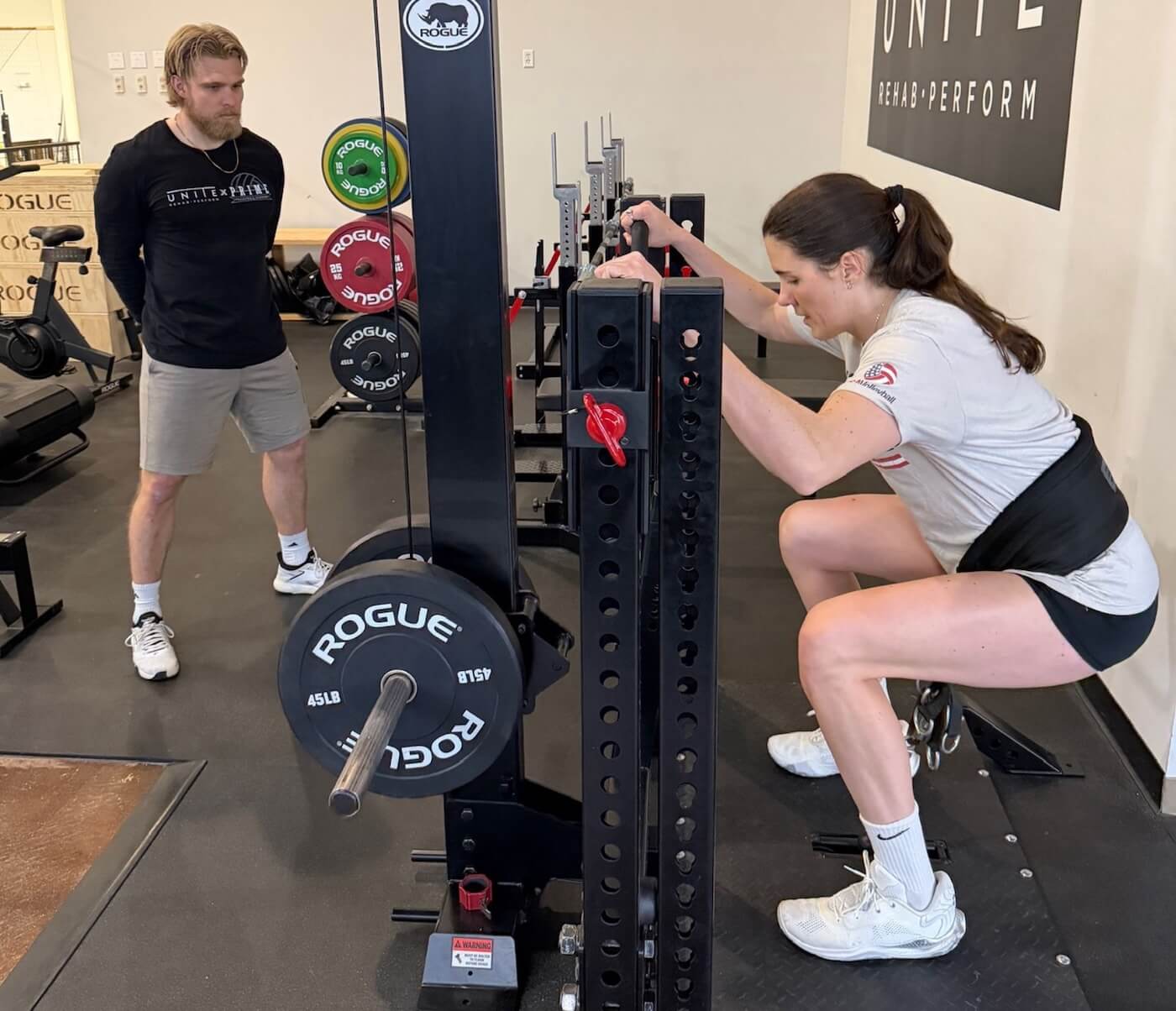
Step 1 — Heavy Squat (Strength Primer)

Load: 80%+ of your 1RM | Reps: 1–3

The purpose here is not to build fatigue. It’s to fire up the nervous system with a maximal contraction so everything that follows is faster and more explosive. You should finish the set feeling powerful, not gassed.

Coaching cue: Move the weight with aggression and perfect form.

Step 2 — Loaded Jump (Power With Resistance)

Load: Light dumbbells or trap bar | Reps: 1–3

This keeps resistance in the equation while still demanding high movement speed. A good starting point for most athletes is around 10 lb dumbbells per hand, adjusted based on speed and quality.

Rule: If jump height or speed drops, the load is too heavy. Strip it down and go faster.

Step 3 — Bodyweight Plyometric (Max Speed + Elasticity)

Options: Hurdle hops, depth jumps, approach jumps | Reps: 1–3

This is where the primed nervous system converts into true explosive output. Keep reps low so every single rep is sharp, fast, and intentional.

Step 4 — Assisted Plyometric (Overspeed Jump)

Option: Band-assisted vertical jumps | Reps: ~5

Band assistance pushes you faster and higher than you could get on your own, teaching your nervous system exactly what elite output feels like. The more familiar that feeling becomes, the easier it is to replicate without assistance.

Goal: Quick ground contacts, maximal intent, uncompromising quality.
Rest Periods (Treat This Like Power Training, Not a Circuit)

French Contrast only works if you arrive at each exercise fresh enough to produce real output.

  • — Rest between exercises: 30–60 seconds
  • — Rest between sets: 3–5 minutes

If you turn this into a conditioning circuit, you will train endurance. Not power. You do not jump higher on tired legs — full stop.

How Often to Do French Contrast Training

  • 2–3 sessions per week is the sweet spot for most athletes
  • — Allow at least one full rest day between sessions. Nervous system recovery is the limiting factor here, not muscle soreness
  • Pair with your strength training days rather than stacking it on top as a separate layer of volume
  • — Most athletes see meaningful vertical jump gains within 4–8 weeks of consistent, high-quality sessions

Common Mistakes to Avoid

French Contrast is simple in structure but easy to execute poorly. Watch for these:

  • — Turning it into conditioning — too many sets, too little rest, chasing fatigue instead of output
  • — Cutting rest short between sets — 3–5 minutes is not a suggestion, it is the method
  • — Loading the jumps too heavy — if you cannot move fast, you are not doing power training
  • — Low intent on plyometrics — every rep should be a maximal effort, not a casual hop
  • — Too much total volume — 3–5 sets of 4 exercises is more than enough

Beginner Modifications

New to plyometric or power training? Dial back the protocol before progressing to the full version:

  • — Reduce squat load to 60–70% of your 1RM and prioritize bar speed over weight
  • — Skip the assisted plyometric (Step 4) until you have built a foundation of clean jump mechanics
  • — Use simple vertical jumps in place of depth jumps — master the pattern before adding complexity
  • — Start with 2 sets per session and build toward 3–5 over several weeks

Get the pattern right first. Intensity will take care of itself once the mechanics are locked in.

Sample French Contrast Workout (Vertical Jump Focus)

Perform 3–5 sets:

  1. 1. Heavy Back Squat @ 80%+ × 1–3
  2. 2. Dumbbell Loaded Jump × 1–3
  3. 3. Bodyweight Plyo (depth jump or approach jump) × 1–3
  4. 4. Band-Assisted Vertical Jumps × 5

Rest 30–60 seconds between exercises. Rest 3–5 minutes between sets.

Why French Contrast Works for Vertical Jump

French Contrast works because it trains the nervous system to transition from high force to high velocity. That is the exact demand of jumping higher in sport, and it is a quality that traditional strength training alone rarely develops.

If your vertical has plateaued, or you have been grinding away in the weight room without seeing it translate to your jump, this is likely the missing piece. A bigger squat matters. But if that strength never converts to speed, it will never show up at the rim or the net.

Commit to low fatigue, high intent, adequate rest, and consistent weekly exposure. Do that, and you will build a more explosive athlete with a real shot at adding 3–5 inches to your vertical over time.

If you’ve been putting in the work and your vertical still isn’t where it needs to be, the issue isn’t effort.

It’s programming. At UNITE, we assess how you move, identify what’s limiting your power output, and build a plan that actually translates to performance.

Book Your Performance Assessment →

Don’t leave it to chance.

Let Denver’s premier team of sports physical therapists and performance coaches lead the way!