UNITE.rehab.perform
Denver's Best Sports Physical Therapy
Build Bulletproof Shoulders
3 Functional Shoulder Stability Exercises for Stronger Performance
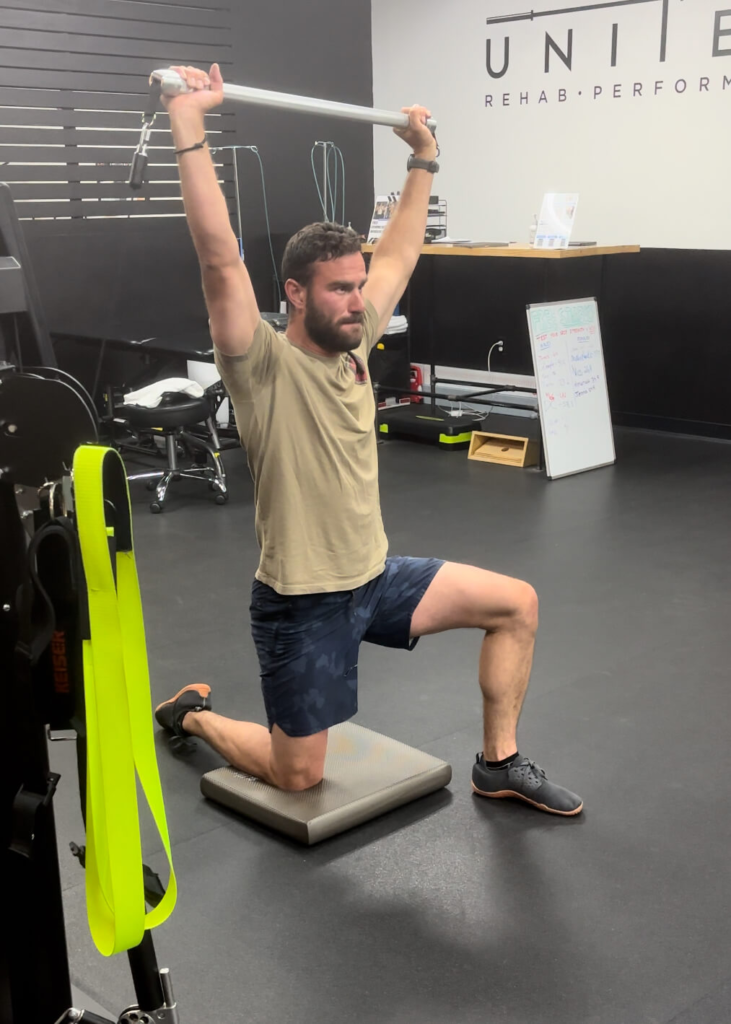
Strong shoulders are not built by chasing a pump or isolating one muscle at a time. They are built through control, coordination, and the ability to stay stable while the rest of the body moves.
That matters because shoulders are rarely asked to work alone. In sport and real life, they stabilize while you throw, brace, sprint, rotate, land, and absorb force. If the shoulder cannot manage that job, pain, breakdown, or compensation usually follows.
That is why shoulder stability exercises matter far more than traditional shoulder workouts. The goal is not just strength. The goal is resilient, adaptable shoulders that hold up under speed, fatigue, and unpredictable movement.
Below are three functional shoulder stability exercises that do exactly that. No equipment required. Just intention and control.
1. Bear Crawl
A Foundation for Shoulder Stability and Control
The bear crawl looks simple. It is not.
This movement forces your shoulders to support bodyweight while coordinating with the core and hips. Every step demands scapular control, trunk stability, and joint awareness.
How to do it
- — Start on all fours with hands under shoulders and knees under hips
- — Brace your core as if preparing for impact
- — Lift your knees slightly off the ground
- — Move opposite hand and opposite foot together
Progressions
- — Forward crawl for baseline control
- — Backward crawl to increase demand
- — Sideways crawl to challenge coordination without crossing limbs
Why it works
Each step asks the shoulder to stabilize while resisting rotation and collapse. This mirrors what happens during sprinting, cutting, grappling, and bracing in contact. It builds shoulder strength that transfers, not just strength that looks good in the mirror.
2. Push Up to T
Teaching the Shoulder to Stay Strong While Rotating
Many shoulder issues show up when the arm moves, but the shoulder blade does not know how to follow. This exercise addresses that problem directly.
The push-up to T trains pressing strength while reinforcing smooth scapular movement and rotational control.
How to do it
- — Start in a push-up position with hands under shoulders
- — Perform a controlled push-up up
- — At the top, rotate your torso and reach one arm toward the ceiling
- — Return to center and alternate sides
Scaling option
If the push-up is too demanding, remove it. Start from a plank and rotate into the T. You still train shoulder stability without sacrificing quality.
Why it works
This drill teaches the shoulder blade to move with control around the rib cage. That coordination is critical for throwing, overhead lifting, and absorbing force through the arms without irritation.
3. Quadruped Kick Through
Rotational Stability Under Real World Demands
Sport does not happen in straight lines. Neither should shoulder training.
The quadruped kick through challenges the shoulder to stay organized while the body rotates around it. This is one of the most honest ways to test and build dynamic shoulder stability.
How to do it
- — Start in a quadruped position with hands under shoulders
- — Shift weight into one arm
- — Rotate and kick the opposite leg through under the body
- — Return to start and alternate sides
Scaling option
Lightly tap the foot to the floor during the kick-through if balance is limiting control.
Strong Shoulders Are Built Through Movement, Not Isolation
Shoulder stability is not about doing more exercises. It is about doing the right ones.
When shoulders learn to manage load, rotation, and coordination together, athletes move with more confidence and less hesitation. Pain decreases. Control improves. Performance follows.
Add these shoulder stability exercises to warm-ups or training sessions two to three times per week. Focus on quality, not speed. Control always comes first.
Build Stronger, More Confident Athletes at UNITE.rehab.perform
At UNITE.rehab.perform, we train shoulders the way sport demands. Through movement-based strength training and youth performance programs, we help athletes develop shoulder stability that lasts through growth, competition, and long seasons.
If you want your athlete to move with confidence, control, and resilience, this is where it starts.
Join our Youth Small Group Performance Training and help your athlete build shoulders they can trust.
©2020-2025 UNITE.rehab.perform LLC. All rights reserved.
UNITE.rehab.perform does not provide medical advice, diagnosis, or treatment through this website or related content. See additional information.